Your Site Is a Knowledge Base: The Content Model That Makes AI Integration Actually Work
By Mr. Oleksandr Nashyvan · CEO ·

Most websites are not knowledge bases. They are collections of pages that happen to share a domain. Content is scattered: some facts live in a database, some are hardcoded in templates, some exist in three slightly different versions across three different pages. When someone updates a team member’s name, they update it in four places and miss a fifth. When a price changes, two translated pages get the fix and one stays wrong for months. This is not a content model. It is managed chaos.
When we rebuilt Moonion’s site, we treated this problem as a first principle, not an afterthought. The result is what we now call the “site as a connected knowledge base” model, and it changes how content is created, maintained, updated, and read, whether the reader is a human visitor, a search engine crawler, or an AI agent.
Everything Starts With Simple Text Files
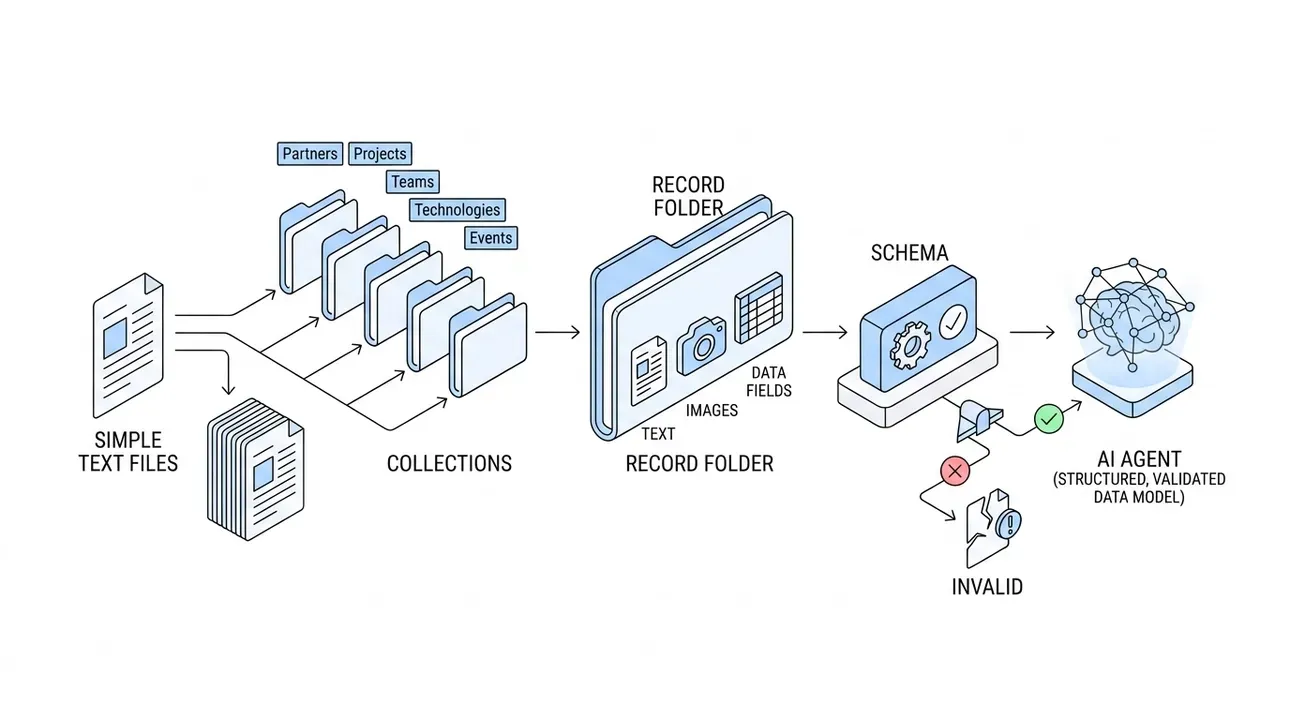
The foundation is deliberately plain. All content on the Moonion site lives in simple text files. No proprietary database, no binary blobs, no content locked inside application code. Just structured text that a person can open in any editor, that a version control system can track line by line, and that an AI agent can parse without needing a special API or a database connection.
The power is not in the files themselves. It is in the structure around them.
Content is organized into collections, which are sets of similar records. The shape of those collections is designed specifically for each site. For Moonion, which is a portfolio site, the collections are: partners, projects, teams, technologies, and events. Each collection is built for a specific type of entity, and every record in that collection follows the same shape.
Each record lives in its own folder. The text, images, and data fields for that entity all live together in one place. Everything about a single project, partner, or team member is in one folder, not spread across a database table, a media library, and a template file that only a developer can find.
On top of this sits a schema, which is a set of rules defining what a valid record looks like. The schema checks that required fields are filled in, that dates are formatted correctly, that images have alt descriptions, and that references point to records that actually exist. If a project references a technology that has no record in the technologies collection, the validation fails. If an image is missing its alt text, that is an error, not a warning. The schema is the quality gate that keeps the knowledge base coherent.
This matters for AI. An agent working with this content is not parsing arbitrary HTML or guessing at what a page is about. It is reading a structured, validated data model. It knows what fields exist, what they mean, and how they connect to other records.
Connections Are Stored, Not Copied
This is the principle that separates a knowledge base from a document collection.
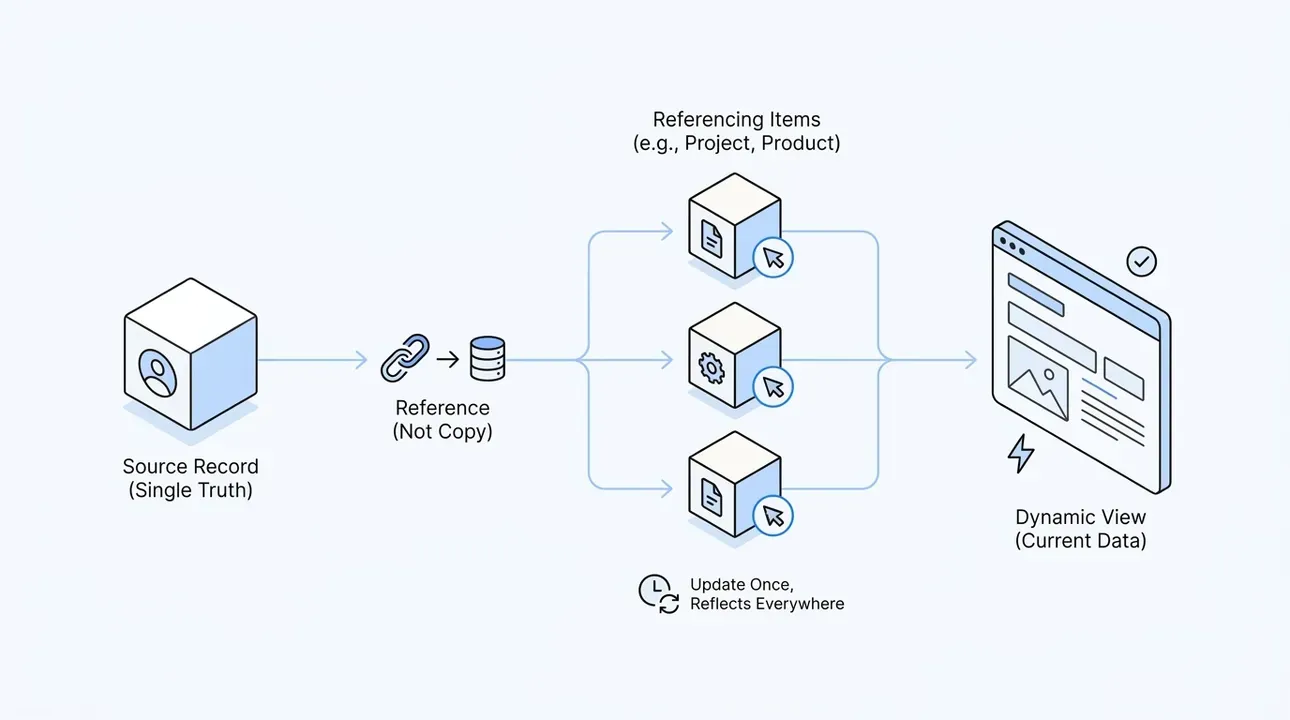
When a project is connected to a partner, we store a reference to that partner’s record. We do not copy the partner’s data into the project record. The project says “this belongs to Partner A,” and when the page renders, it pulls Partner A’s current data at that moment.
What this means in practice: update the partner once, and the change is correct everywhere that partner appears. There is no synchronization step, no risk of one page showing old data while another shows new data, no developer task required to propagate the change. The connection is the data.
The same principle applies at every level. In the Moonion portfolio, a project is connected to its partner, its team, the technologies used, and any related events. The partner page automatically surfaces the projects associated with that partner. The technology page shows the stack context across all projects that reference it. The site becomes navigable as a network, not just as a list of pages, and that navigation emerges from the data model, not from manually maintained link lists.
We are also applying this same model to an e-commerce project currently in development. There, the collections are products, categories, brands, attributes, services, and articles. A product is connected to its brand, its categories, and its attributes. Update the brand record once, and every product that references it reflects that update automatically. The principle is the same; only the domain changes.
Multilingual sites benefit especially clearly from this model. Shared facts, such as price, availability, product specifications, and images, are stored once in the primary record. Translations contain only the text that actually needs translating: titles, descriptions, captions. A price cannot diverge between language versions because there is only one price field, and it lives outside the translation layer. A factual error in a translation becomes structurally harder to introduce because the translation does not hold the facts.
AI as the Interface, With Honest Limits
Clients who come to us typically expect an admin panel. They are used to a form where they fill in fields and click save. When we tell them everything lives in text files, the reaction is usually skepticism. Files feel like a developer tool, not a business tool.
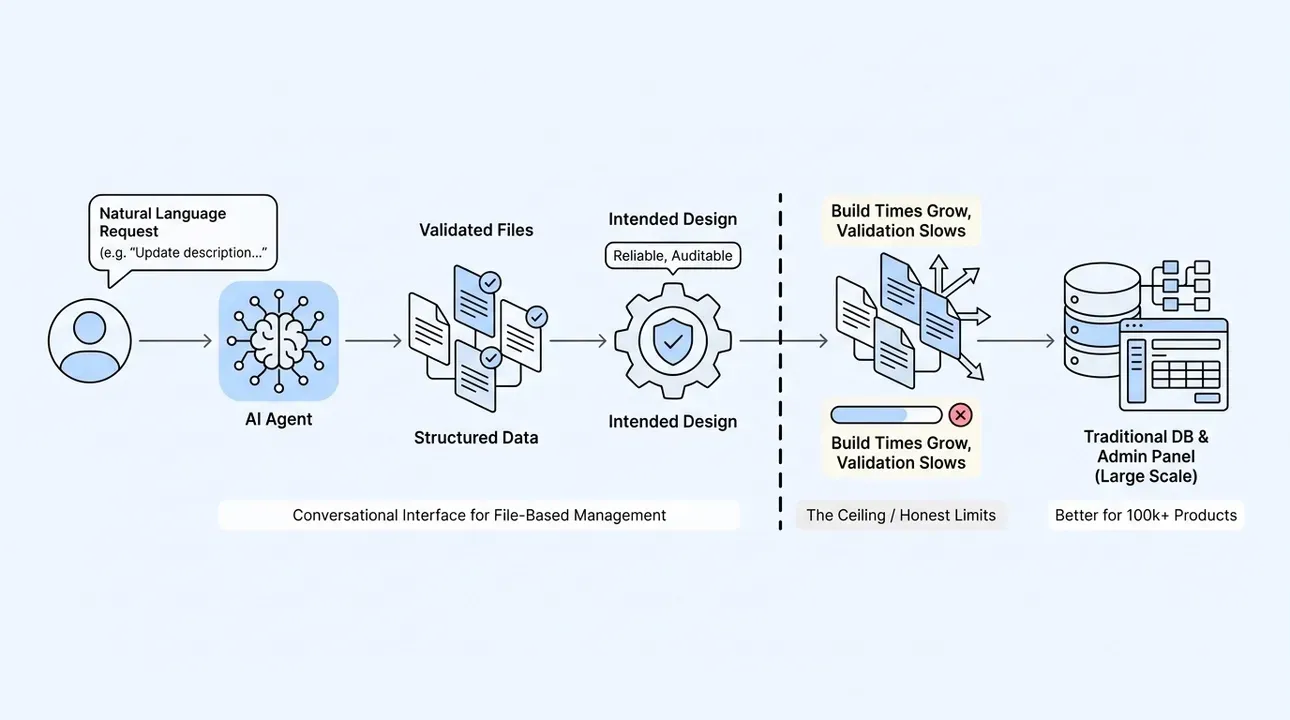
This is where the AI agent changes the picture. The client does not interact with files directly. They talk to an AI agent in natural language: “Update the description for project X,” or “Change the availability status on this product.” The agent understands the request, locates the correct record in the file structure, makes the change, and the schema validation catches anything that would break consistency. The client gets an interface that feels conversational. The system underneath stays structured and auditable.
This is not a workaround. It is the intended design. The file-based model is what makes the agent reliable, because the agent is working with a clear, validated data model rather than trying to interpret a database schema it cannot see or modify HTML it might accidentally break.
That said, this model has a real ceiling, and we are direct about it. For a site with a hundred thousand products, the approach starts to strain. Build times grow as the static generator has to resolve connections across a very large number of records. Validation across that many relationships becomes slow. The development experience, which is already the main cost of this approach, degrades further. For projects of that scale, a traditional database with a proper admin interface is almost certainly the right tool.
The file-based knowledge base model is well-suited to projects where the content set is manageable: portfolio sites, marketing sites, small to mid-size product catalogs, documentation sites. If you are in that range, the simplicity and reliability are genuine advantages.
A Structure That Stays Useful Over Time
One practical benefit that clients do not always think about upfront is what happens when the business outgrows the current setup.
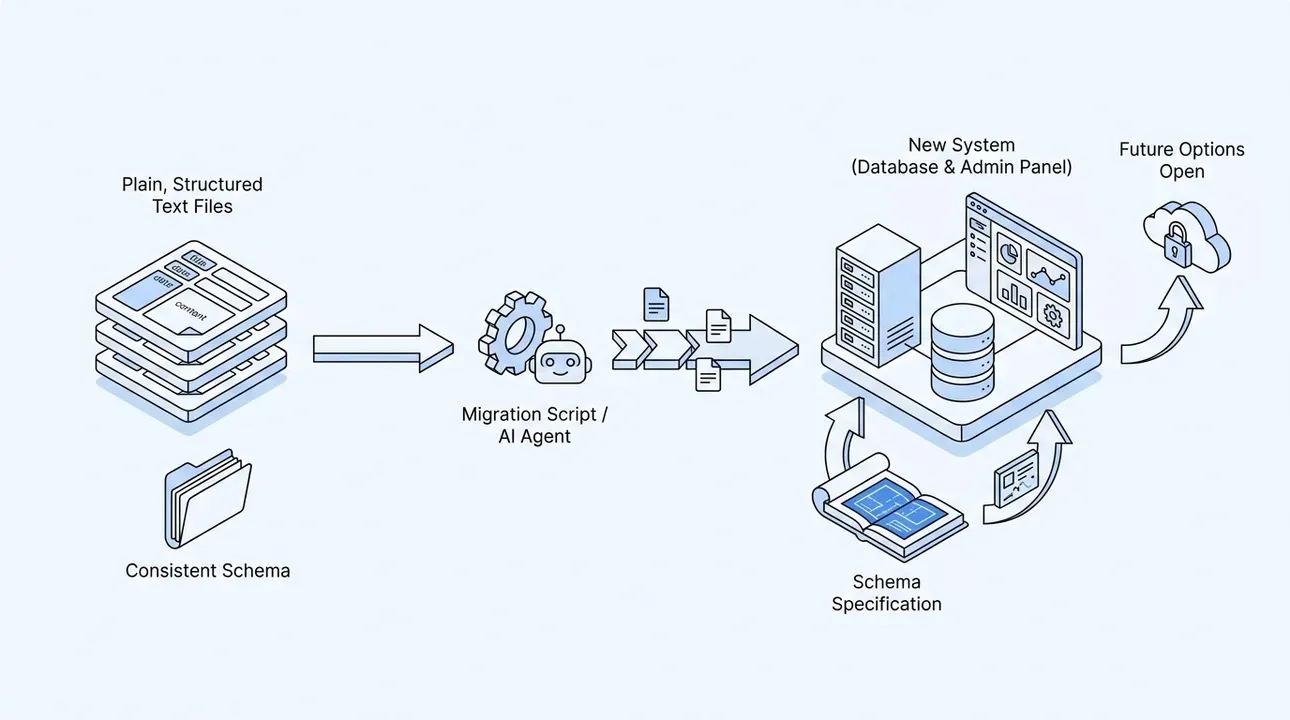
Because all content lives in plain, structured text files with a consistent schema, migrating to a different system later is a tractable problem. The data is not locked inside a proprietary database format or buried in serialized application state. It is in files with known structure. Writing a migration script, or having an AI agent do it, is straightforward compared to extracting content from a system that was never designed to export it cleanly.
If that hypothetical e-commerce project grows to the point where it genuinely needs a database backend and a traditional admin panel, the migration path is clear. The file structure documents exactly what fields exist, what their types are, and how records relate to each other. That specification becomes the schema for the new system. The content moves without guesswork.
This is the long-term value of treating structure seriously from the start. A well-defined content model does not just make the current site easier to manage. It keeps future options open.
What This Actually Changes
A website built as a connected knowledge base works differently from a collection of pages in ways that accumulate over time. Visitors navigate by context rather than just by links. Potential clients see real connected evidence of work, not isolated service descriptions. Search engines find a coherent set of documents that reference each other meaningfully. AI chat interfaces, when they access the site, receive a structured set of facts with explicit relationships rather than a pile of loose text.
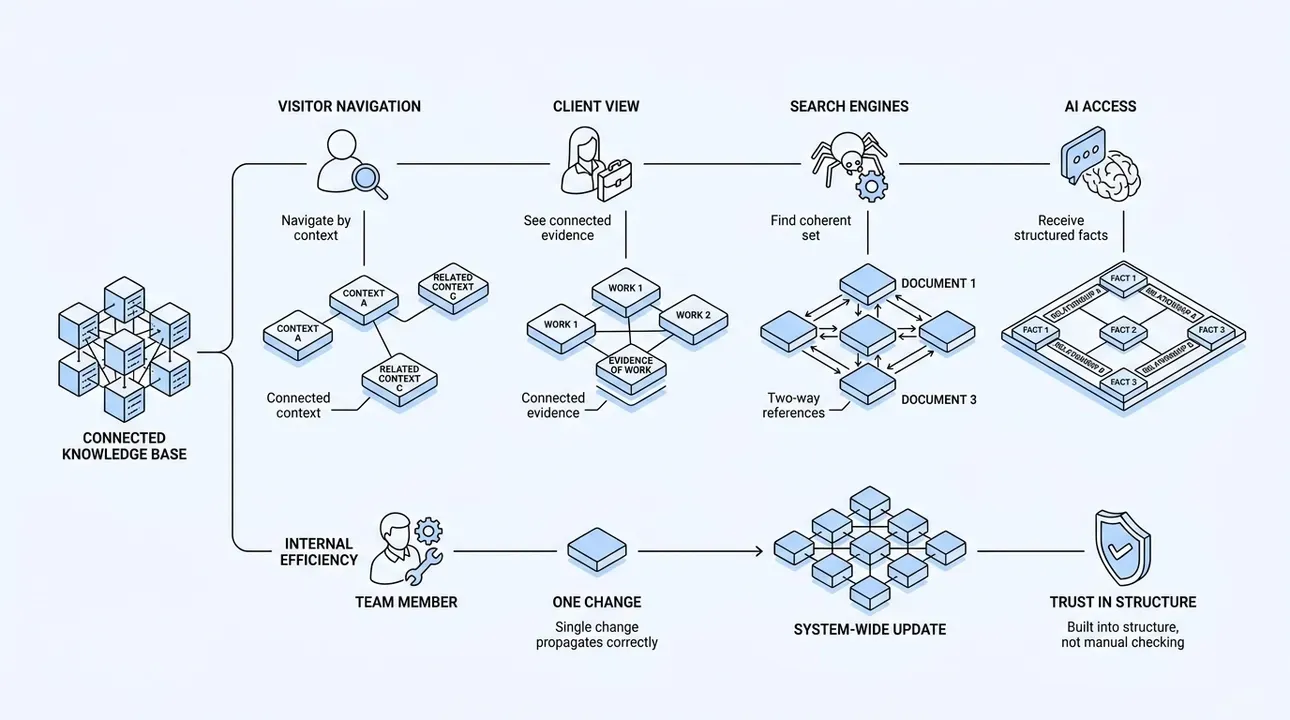
And internally, the team makes one change and trusts that it is correct everywhere. That trust is not based on careful manual checking. It is built into the structure itself.
That is what a knowledge base does. It turns individual records into a system that stays consistent as it grows, and stays readable to every audience that needs to use it.