Content Without a Developer: How AI-Ready Sites Put Clients Back in Control
By Mr. Oleksandr Nashyvan · CEO ·

There is a moment every client knows. You need to update a service description, add a new case study, or fix a product card. It is a five-minute job in your head, but in practice it means writing to a developer, waiting for them to fit it into their schedule, reviewing the change three days later, and then starting over if something is slightly off. That cycle is not a technical limitation. It is a structural one, and it is exactly what an AI-ready architecture is built to solve.
This is post five in our AI Ready Series. The earlier posts covered why speed is a conversion problem, how we rebuilt our own site before recommending the approach to anyone else, and what it actually means for a product to be AI-ready. Now we are getting into something more operational: what it looks like when a client can manage their own content, and why that does not mean handing the keys to an AI and hoping for the best.
The Problem With the Old Workflow
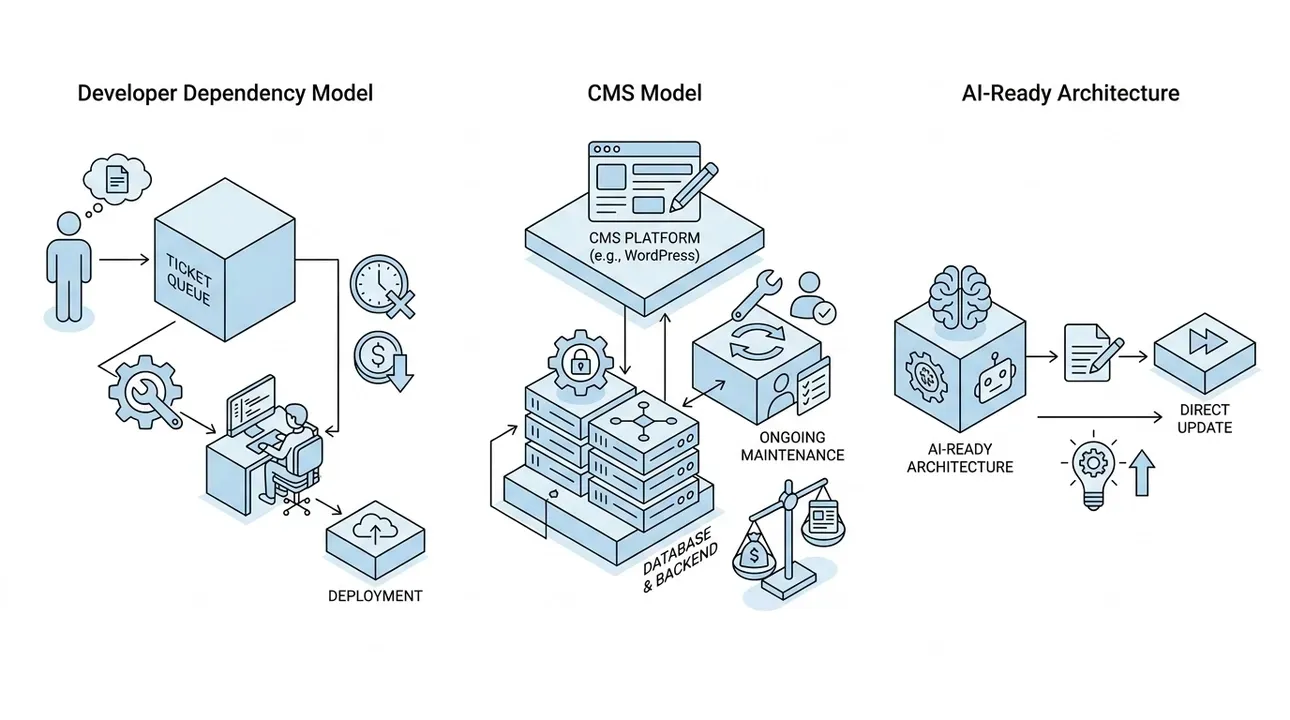
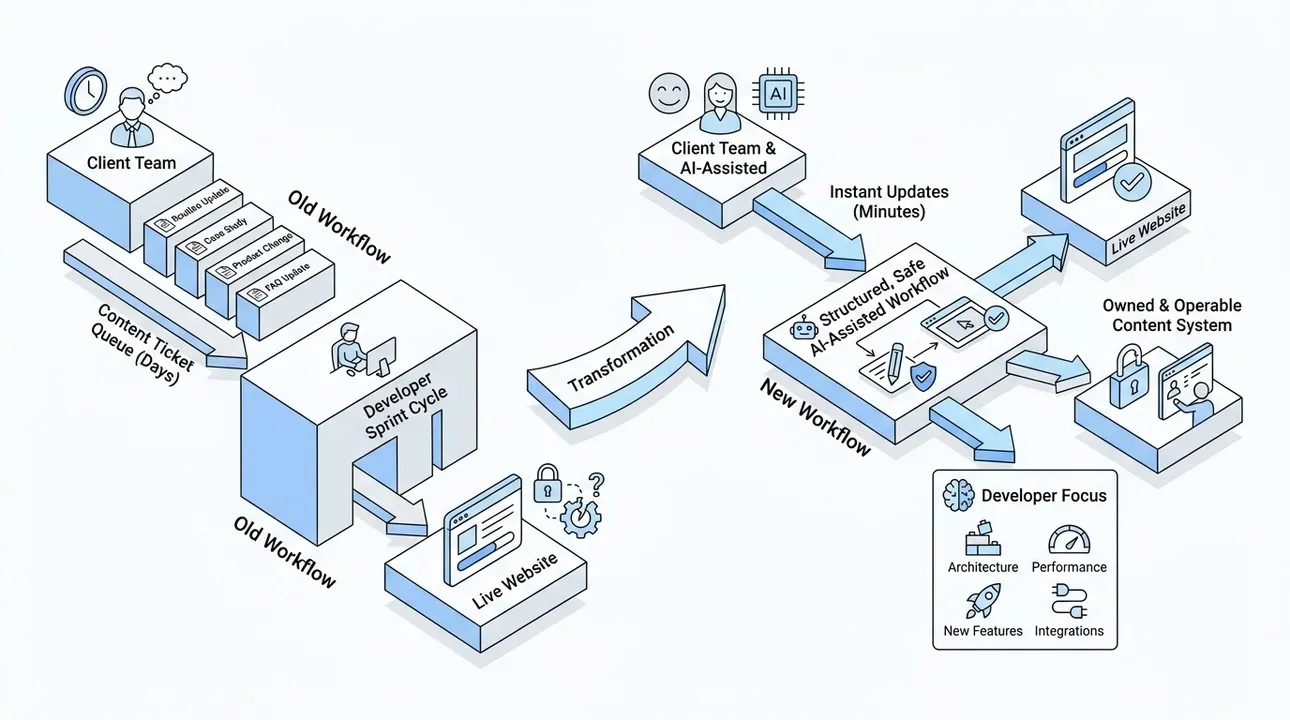
The traditional content update process has two shapes, and neither is great.
The first is the developer dependency model. Every change, no matter how small, goes through a ticket, a queue, and a deployment. This is slow, expensive for routine tasks, and frustrating for everyone involved. Developers did not get into this work to update FAQ entries.
The second is the CMS model. Platforms like WordPress or custom admin panels were built to solve exactly this problem, but they introduced a different one. They require a database underneath them, a backend to manage, user permissions to configure, and ongoing maintenance. For many projects, the infrastructure cost of a heavy CMS outweighs the content management benefit it was supposed to deliver.
An AI-ready architecture takes a different path entirely.
What AI-Assisted Content Editing Actually Looks Like
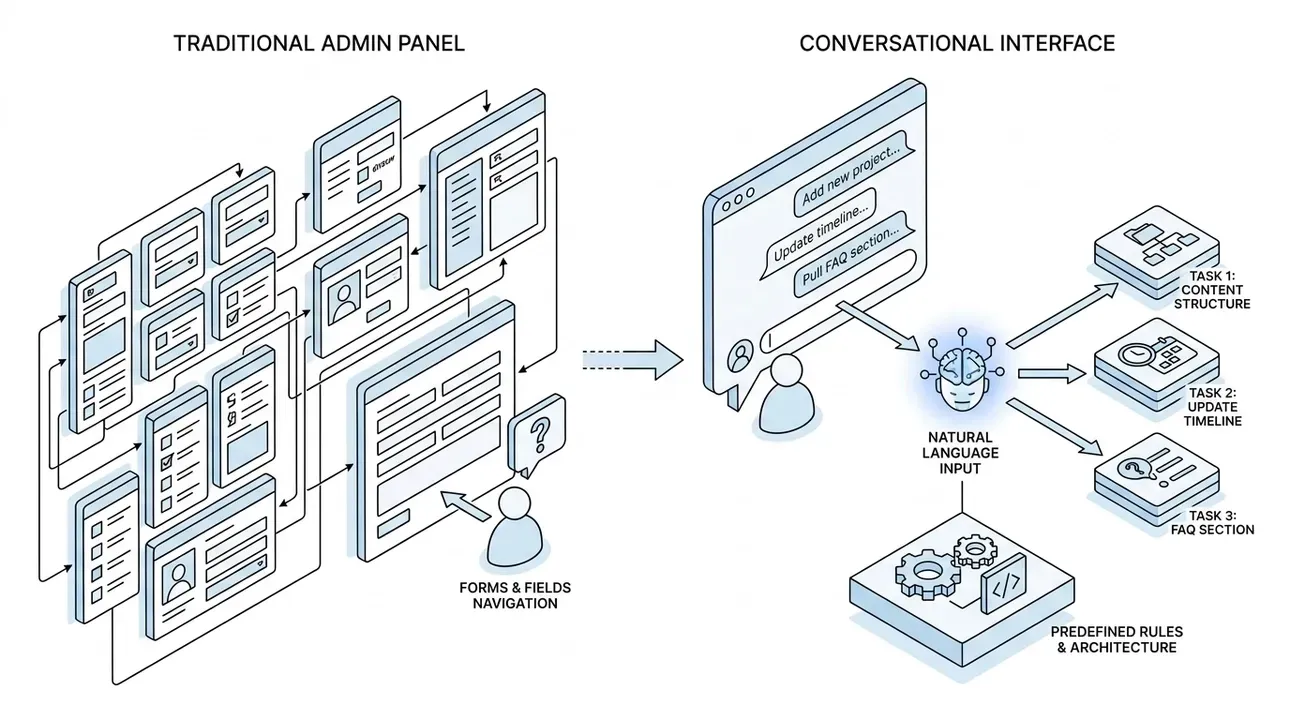
The shift is straightforward to describe, even if it took real architectural work to get right. Instead of an admin panel with forms and fields, the interface is a conversation with an AI agent.
A client sits down and writes something like: “Add a new project. Here is the name, the description, a couple of links, and two photos.” Or: “Update the timeline on this case study.” Or: “Pull these five questions together into a FAQ section.” That is the entire input. Natural language. No panel to navigate, no fields to hunt for, no dropdowns to configure.
The AI agent takes that request and does the actual work: it finds the right files, understands the content structure of the project, makes the specific changes requested, and leaves everything else untouched. It knows where things live and what the rules are, because those rules are defined in advance as part of the project architecture.
This is not magic, and it is not autonomous publishing. It is a well-scoped tool doing a well-defined job.
Why This Is Safe: Three Layers That Protect the Output
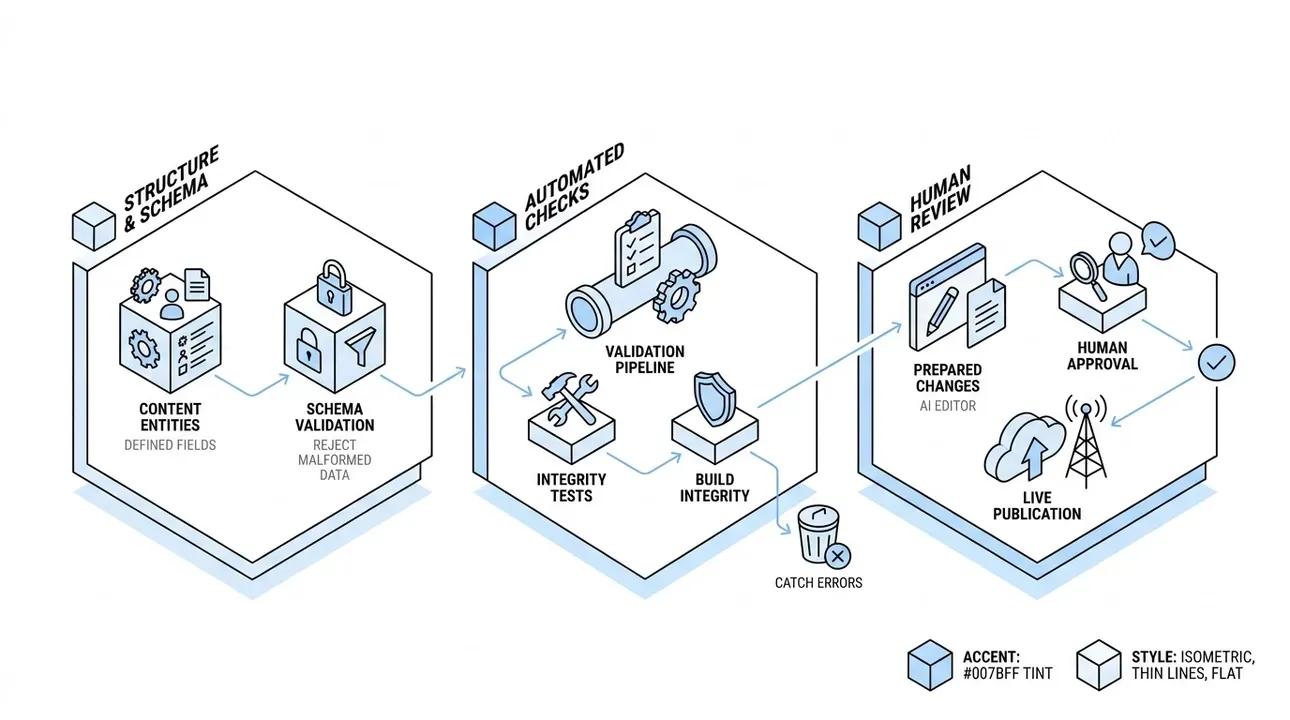
The most common concern we hear when we describe this is predictable: what stops the AI from breaking something, or worse, publishing something wrong? It is a fair question. The answer is that safety here is not a single feature, it is a layered system.
The first layer is structure. Before any client ever touches the system, we define the content entities for that specific project. On a portfolio site, those entities might be projects, partners, technologies, and highlights. On an e-commerce site, they would be products, categories, shipping options, and FAQ entries. Each entity has defined fields and relationships, and a schema sits underneath that simply rejects anything malformed. If the data does not fit the structure, it does not go through. The AI cannot publish a project without a title, or add a technology that does not match the expected format, because the schema will not allow it.
The second layer is automated quality checks. Any change made through the AI agent runs through the same automated validation pipeline that a developer’s code would pass through. These are not special content checks invented for clients. They are the same structural tests we use on every build. If something breaks the integrity of the project, the pipeline catches it before anything reaches the live site.
The third layer is the human. The AI prepares the changes, but a person reviews the facts and approves the publication. That final decision never moves to the machine. The AI is a capable editor, not an autopilot. The client sees what is going to be published, confirms it is accurate, and then it goes live. That sequence does not change.
All three layers work together. Structure prevents bad data from entering the system. Automated checks catch anything that would break the build. Human review ensures the facts are right before the content is live.
What This Replaces and What It Keeps
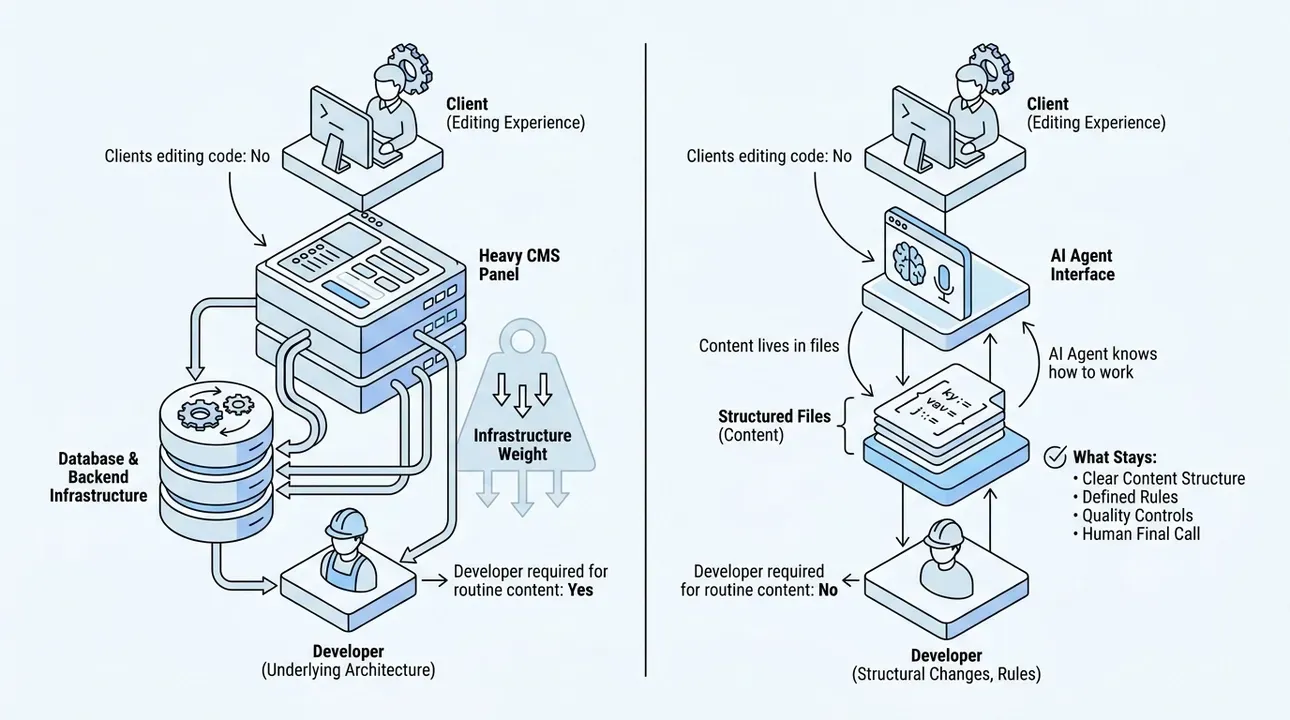
It is worth being precise about what this approach does and does not replace, because it is easy to misread the idea.
This does not mean clients are editing code. They are not. The underlying architecture is still managed by developers, and complex structural changes still go through us. What changes is the surface layer: the routine content work that should never have required a developer in the first place.
This also does not mean the heavy CMS disappears from every project in every context. What it means is that for projects built on a static, AI-ready architecture, you no longer need the database and backend infrastructure that a traditional CMS requires just to let a client update a product description. The content lives in structured files. The AI agent knows how to work with them. The result is the same editing experience a client used to get from a panel, but without the infrastructure weight underneath it.
What stays is everything that matters: clear content structure, defined rules for what belongs where, quality controls on every change, and a human making the final call.
What This Means for the Business
The practical impact is straightforward, and clients feel it quickly.
Routine updates that used to take days now take minutes. A new case study does not wait for a developer’s sprint cycle. A product description change does not sit in a queue. An FAQ update happens the same afternoon someone realizes it needs to happen. The team stops treating small content changes as tasks that require coordination, because they no longer do.
Developers, meanwhile, get to focus on the work that actually requires their skills. Architecture decisions, performance work, new features, integrations. Not content tickets.
For the client, this creates something that is genuinely different from what most websites offer: a content system they actually own and can operate. Not a portal they were handed and never really understood. Not a CMS they are afraid to touch in case something breaks. A structured, safe, AI-assisted workflow where they know exactly what they can change, how to change it, and that nothing will go wrong without them seeing it first.
The Bigger Point
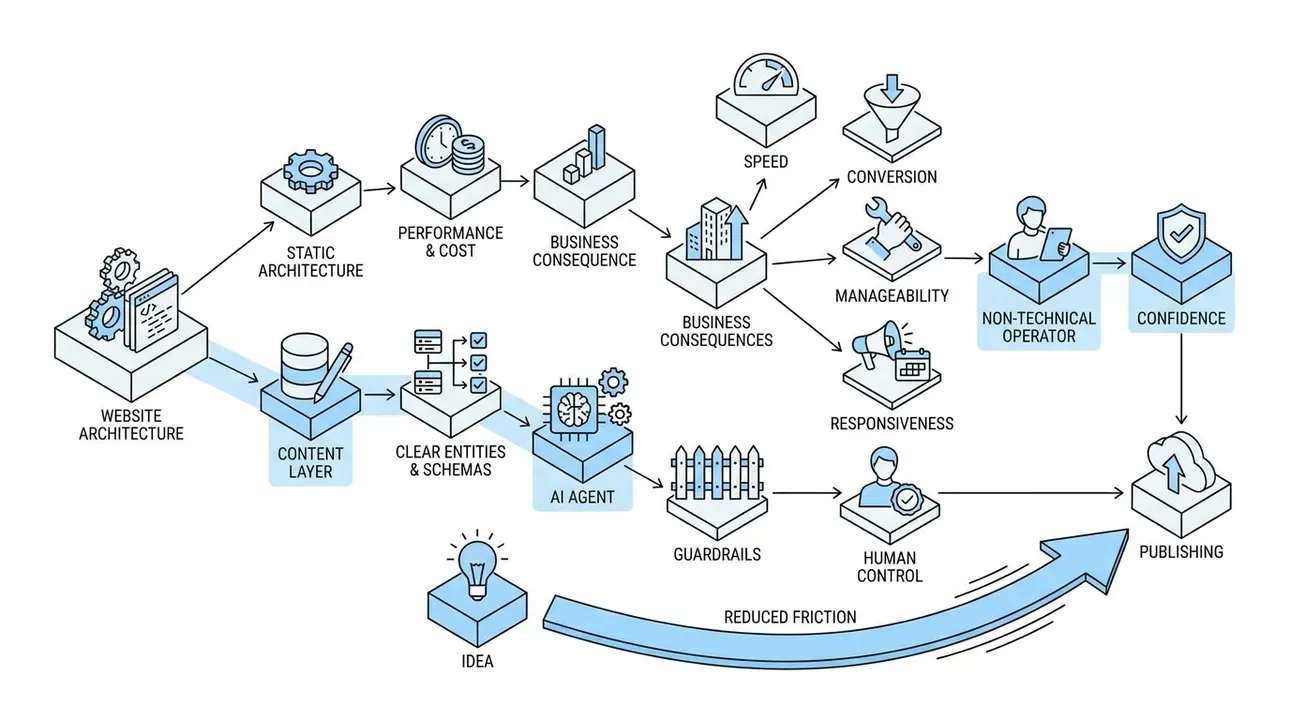
We built the AI Ready Series around a single underlying idea: that the decisions made in how a website is architected have real business consequences, not just technical ones. Speed affects conversion. Static architecture affects performance and cost. And content manageability affects how quickly a business can actually respond to what is happening in the world.
Giving clients the ability to update their own content without developer dependency is not a convenience feature. It is a structural property of a well-built site. When the content layer is designed with clear entities, enforced schemas, and an AI agent that understands the project’s own rules, the result is a system that a non-technical person can operate with confidence, not because the technology is doing everything, but because the right guardrails are in place.
The last word always belongs to the human. That part does not change. What changes is how much of the friction between having an idea and publishing it has been removed.