We Rebuilt Moonion's Own Site Before Pitching the Approach to Anyone Else
By Mr. Oleksandr Nashyvan · CEO ·
It is easy to promise clients a modern, AI-ready website. It is a lot harder to actually build one and live with the results. So before we brought this approach to anyone else, we ran the experiment on ourselves. Moonion’s own site became the case study, and what we learned in the process shaped everything we now offer.
The Stack We Outgrew
The old Moonion site was technically competent. It ran on Next.js, used Apollo GraphQL for data fetching, connected to a backend server, and came with a separate admin interface so non-technical team members could manage content without touching code.
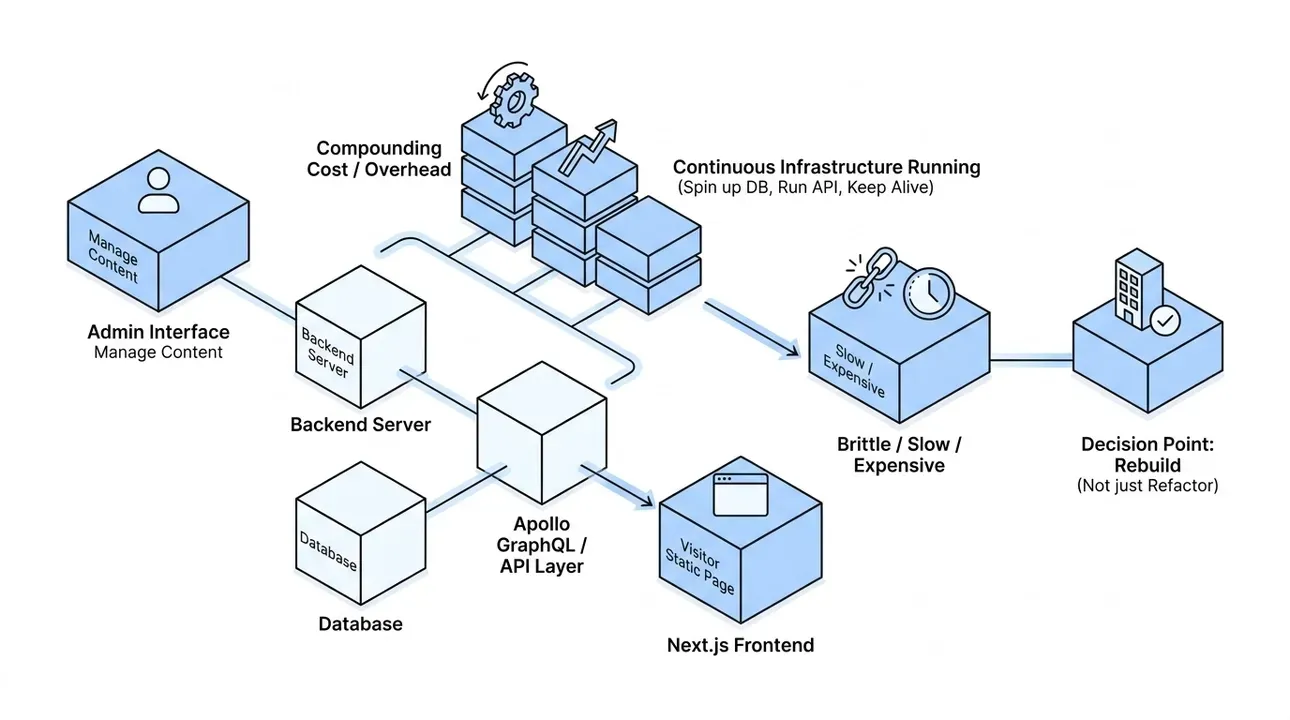
That last part mattered. Not everyone on the team writes code, and they should not have to. When someone needs to add a new project, update a partner description, or swap out a logo, they need a way to do that themselves. The admin interface existed precisely for that reason, and it did its job.
But the cost of that convenience kept compounding. To show a visitor a static page describing a project, the system had to spin up a database, run an API layer, and keep a separate application alive just to serve that content. The full infrastructure was there, running continuously, for what was essentially a content site. Over time, that architecture became slow, expensive to maintain, and brittle in ways that were hard to justify.
Eventually, we realized the architecture no longer reflected the purpose of the site. Instead of maintaining a dynamic platform for mostly static content, we rebuilt it as a static-first website focused on speed, simplicity, and making every page easy for both people and AI systems to understand.
What the New Architecture Is Actually For
The new version of the site was built around a different set of priorities: be fast, be static, be readable by search engines, and be readable by AI systems. Those goals shaped every decision in the migration.
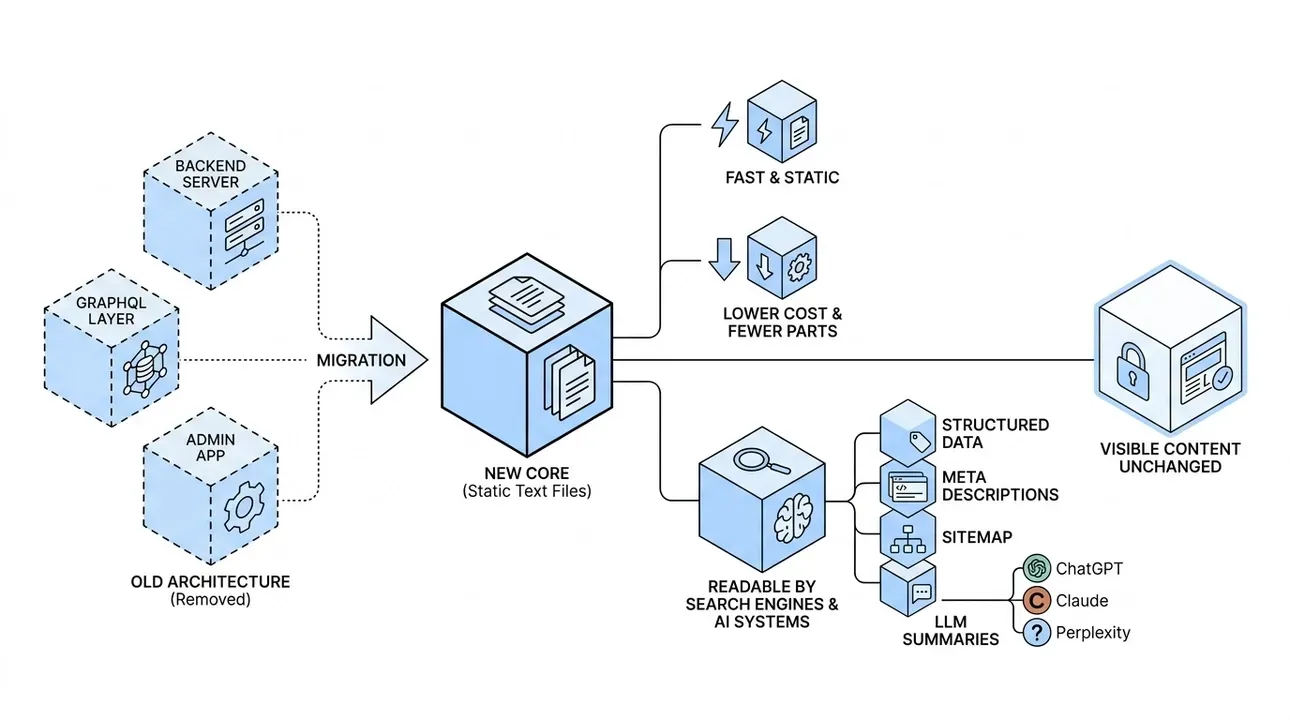
The public site no longer depends on a backend server, a GraphQL layer, or a separate admin application. All public content lives in simple, well-structured text files. That shift alone removed most of the infrastructure that existed purely to support content editing. The site loads faster, costs less to run, and has significantly fewer moving parts that can break.
We also paid close attention to what happens when AI systems try to understand the site. Search engine optimization was only part of it. We added structured data about the organization, wrote clear meta descriptions for each page, kept the sitemap up to date with accurate modification dates, and published LLM-readable summaries for each project and partner. Tools like ChatGPT, Claude, and Perplexity crawl and interpret sites differently than traditional search engines do, and we built with both audiences in mind.
One thing we were deliberate about: we did not rewrite the visible content during the migration. People coming to the site should see the same Moonion they recognized, just faster and better structured underneath. The work was architectural, not cosmetic.
Why the Admin Interface Became Unnecessary
This is the part of the story that surprised us most, and it is also the part most relevant to what we now offer clients.
When we decided to remove the admin application, the obvious question was: what happens to the people on the team who are not developers? How do they update content without a dedicated interface to click through?
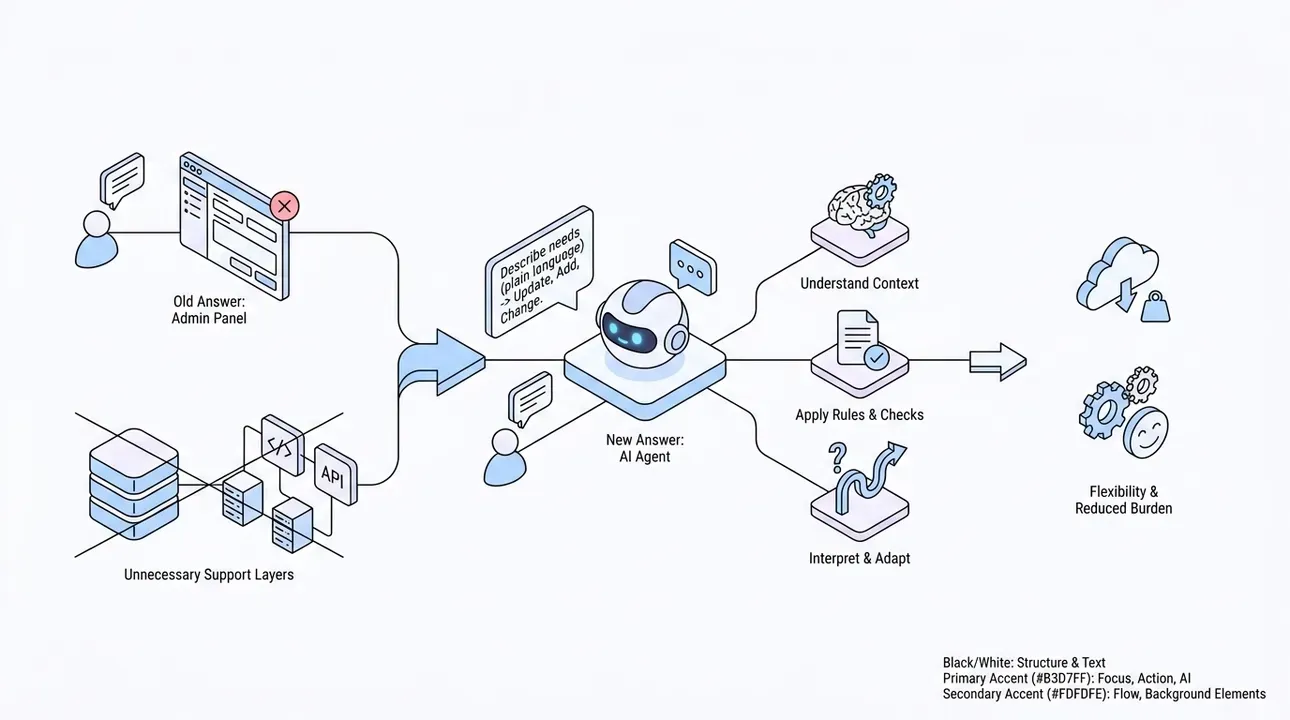
The old answer was: give them an admin panel. The new answer is: give them an AI agent.
A non-programmer on the team can now describe what they need in plain language. Add a new project. Here are the links and the description. Update the text on the partner page. The AI agent takes that instruction, understands the context of the project, applies the relevant content rules, and runs the necessary checks. It does not need a pre-built form with fixed fields. It understands what is being asked and acts accordingly.
The combination of a person and an AI agent handles the same job the admin interface used to handle, and it handles it with more flexibility. A form can only accept what it was designed to accept. An agent can interpret, adapt, and ask clarifying questions when something is ambiguous. The role did not disappear; the tool that fills it changed.
With the admin application gone, the database and API layer that existed primarily to support it also became unnecessary. The infrastructure shrank, the maintenance burden dropped, and the team’s ability to update content did not diminish at all.
A Living Product, Not a One-Time Rebuild
The migration itself was one phase. What came after it is equally important.
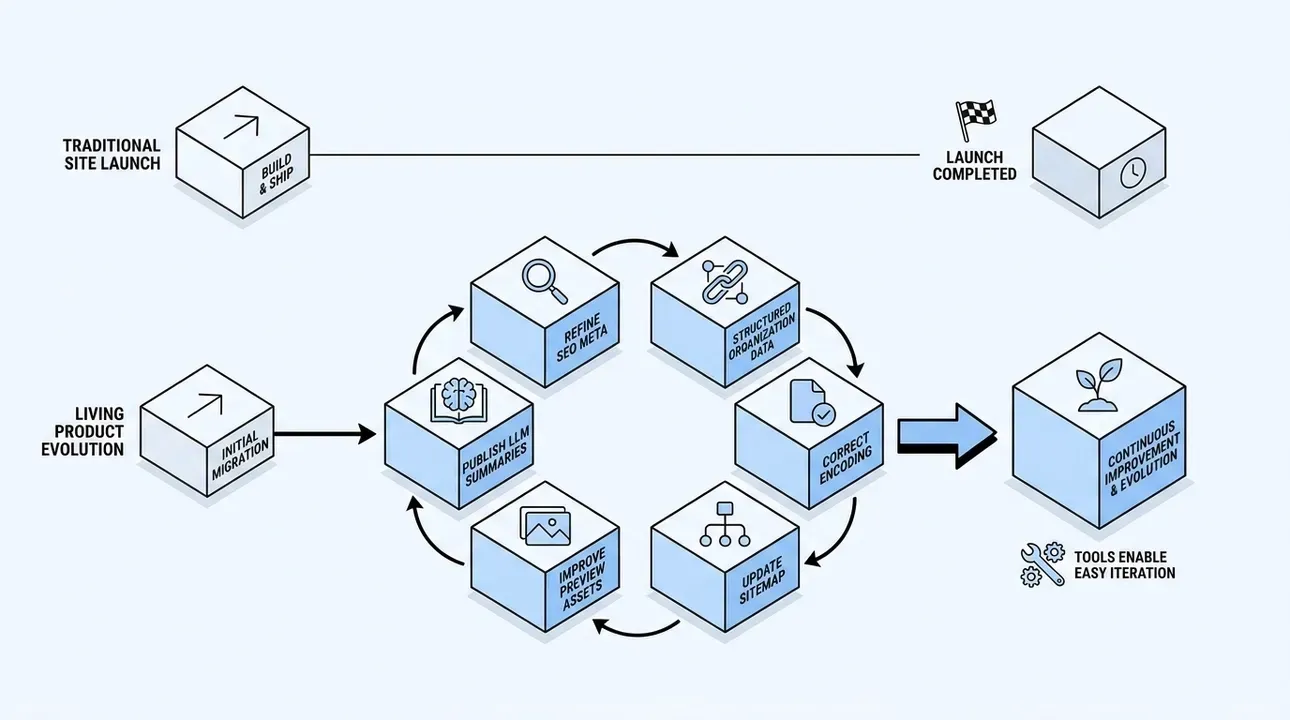
Once the new architecture was in place, a separate wave of improvements followed. Meta descriptions were refined across pages. Structured organization data was added. LLM summaries were published for individual projects and partners. Text file encoding was corrected. Preview logos were improved. The sitemap was kept current.
None of that would have happened if this had been treated as a web project with a finish line. The reason it did happen is that the architecture makes it easy. When content, SEO, the LLM layer, and quality checks are all part of the same coherent system, improving one does not break another. The site evolves continuously because the process is designed to support that.
This is the distinction we care about: the difference between shipping a site and building a product. A site gets launched. A product keeps getting better because someone is responsible for it and the tools exist to make improvement straightforward.
What This Means If You Are Thinking About Your Own Site
Moonion’s rebuilt site is not a slide deck or a proposal. It is a working demonstration of the approach we are now bringing to clients.
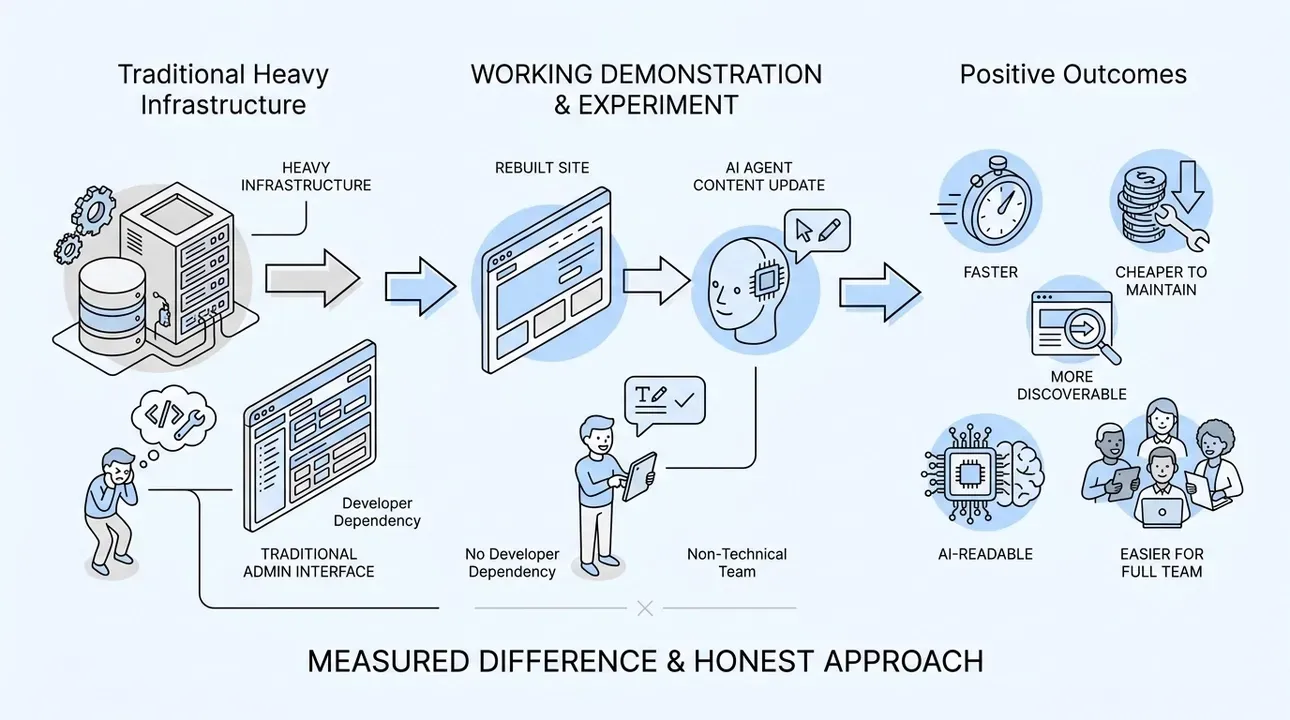
When we talk about removing heavy infrastructure, we are not theorizing. We did it and we measured the difference. When we say an AI agent can replace a traditional admin interface for non-technical team members, we are not speculating. That is how our own team updates content today.
The outcome is a site that is faster, cheaper to maintain, more discoverable in search, more readable by AI systems, and genuinely easier for the full team to work with, not just the developers.
We built this on ourselves first because that felt like the only honest way to offer it. If we were not willing to run the experiment on Moonion, we had no business recommending it to anyone else. The fact that it worked, and that we kept improving it long after the initial migration, is what made it worth writing about.
The same path is available. The infrastructure does not have to be this heavy, and the team does not have to depend on a developer every time something needs to change.