From 59 to 100: Why Website Speed Is a Conversion Problem, Not a Technical One
By Mr. Oleksandr Nashyvan · CEO ·

When we rebuilt our site, the number that surprised people most was not the new design or the content structure. It was the score. Our old site sat at around 89 on desktop and 59 on mobile in Google PageSpeed. After the rebuild, both landed at 100. People asked what trick we used, what plugin we installed, what optimization pass we ran at the end. The honest answer is that there was no trick. The score was a side effect of choosing the right architecture from the start.
That distinction matters more than most people realize.
Speed is what your visitor feels before they read a single word
There is a tendency in development to treat performance metrics as internal concerns, things you report in a sprint review and then move on from. But speed is not something that lives in a dashboard. It lives in the moment a person taps a link on their phone and waits.

A slow site loses people before they ever see what you are offering. A significant share of visitors will leave without waiting for a page to finish loading. They do not bounce because they disliked the product. They bounce because the experience felt broken. And once they are gone, they are gone. No headline, no case study, no call to action gets a chance.
A fast site does the opposite. It creates an immediate sense of reliability. The page appears, the content is readable, and the visitor can decide whether what you are saying is worth their time. That is the baseline you need just to be in the conversation.
Speed also shapes trust in a way that is hard to separate from the product itself. If the site feels slow or clunky on mobile, that feeling attaches to the brand. People do not consciously think “this company has a poorly optimized frontend.” They just feel friction, and friction erodes confidence. For an agency, a portfolio, a SaaS product, or any business where first impressions drive decisions, that friction is expensive.
There is also the search and AI layer to consider. Search engines and AI crawlers use page quality as part of how they evaluate and surface content. A fast site with clean, readable HTML is easier to scan and easier to understand correctly. The structure is transparent. The content is accessible. That matters for discoverability, and it is only going to matter more as AI-driven search continues to expand how people find information.
The architecture is where the score actually comes from
When we hit 100 on both desktop and mobile, it was not because we ran a final round of compression or fine-tuned our image loading. It was because the underlying architecture made those problems smaller to begin with.
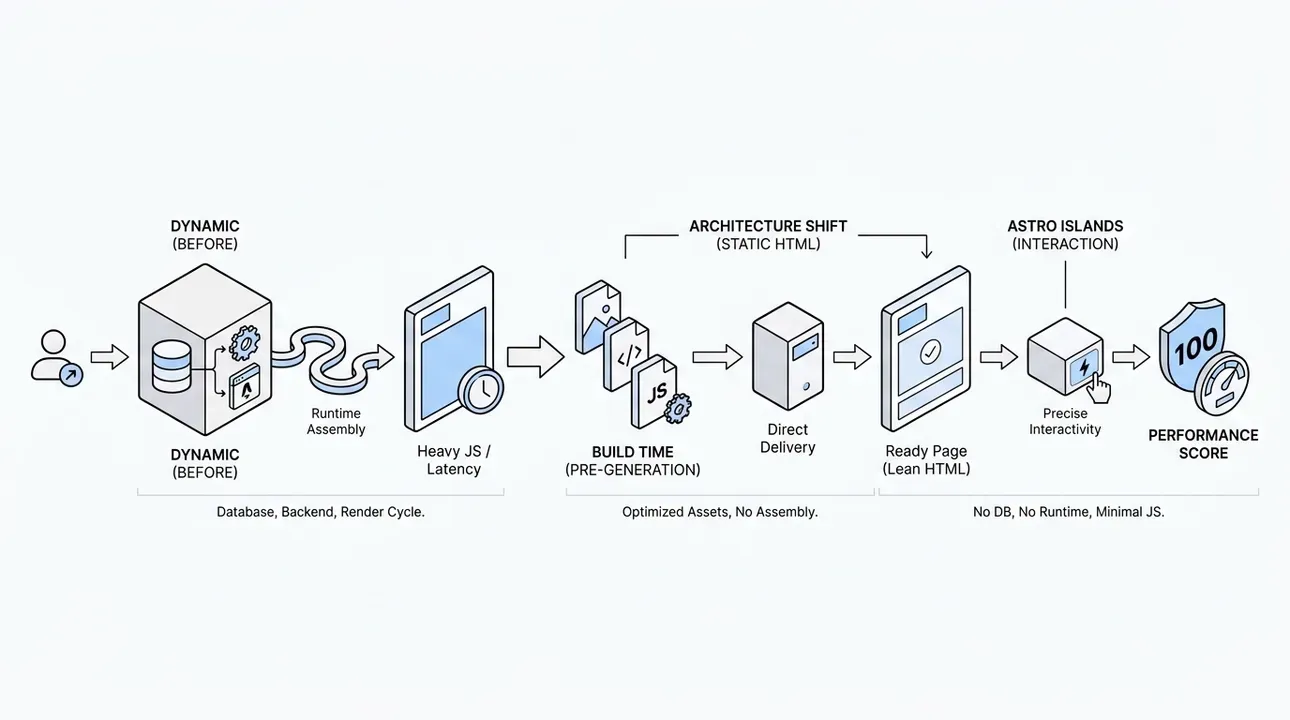
The core shift was moving to static HTML. Instead of building pages dynamically on each request, where a server assembles a response from a database, a backend application, and a framework rendering cycle, our pages are generated in advance. They exist as finished files before anyone visits. When a request comes in, the server delivers a complete, ready-to-read page. Nothing needs to be assembled on the fly.
This changes the performance profile entirely. There is no database query sitting between the visitor and the content. There is no runtime rendering step adding latency. The page is already there. The server’s only job is to hand it over.
We also rethought how much code runs in the browser. A lot of modern sites ship a heavy JavaScript application to every visitor, even when the page only needs to display text and images. That code has to download, parse, and execute before the user sees anything useful. We moved away from that model. Interactive elements still exist where they genuinely serve the experience, but they are added precisely and purposefully. The default is lean, readable HTML, not a full client-side application.
Images were handled at build time rather than on demand. They are optimized before they ever reach a visitor, and they live alongside the content they belong to. No external service, no runtime processing, no additional round trips.
The result is a site where the public-facing pages have no database underneath them, no background application running to generate responses, and minimal JavaScript executing in the browser unless a specific interaction requires it. There is simply less that can slow things down, and less that can break.
We use Astro for this. It fits the model well because its default output is static HTML, and interactivity is added through what the framework calls islands: isolated components that load only where they are actually needed. The mental model aligns with how we think about the problem. Start with nothing in the browser, add only what earns its place.
Why static is a modern choice, not a step backward
The word “static” sometimes reads as old-fashioned, like something from the early web before dynamic applications existed. That framing gets it backwards. Choosing a static architecture today is a deliberate, well-reasoned decision, not a fallback for teams that cannot build something more complex.

Many sites are built like applications when they do not need to be. An agency site, a portfolio, a blog, a documentation hub, most informational pages on an e-commerce site: none of these require a dynamic rendering pipeline. They need to show content clearly, load quickly, and be easy to update. A heavyweight system under the hood does not add capability here. It adds complexity, slows delivery, and increases the cost of ongoing maintenance.
Static architecture solves this differently. Every page, every piece of metadata, the sitemap, the robots file, and any files intended for AI parsing are all generated once, at build time. What runs on the production server is a file delivery system. Fast, predictable, and with very little surface area for things to go wrong.
Content becomes part of the repository. Updates go through a clear, reviewable process. Editing a page does not trigger a cascade of moving parts. This keeps the maintenance burden low, which matters for any team that needs to move quickly without a dedicated ops function watching the infrastructure.
For our clients, the practical translation is straightforward. The site loads instantly. It is less likely to experience downtime. And the ongoing cost of keeping it running and current is lower than a dynamic system of comparable quality. Those are concrete business outcomes, not technical talking points.
What the score actually means
A score of 100 is useful as a signal, but it is not the goal in itself. What it tells us is that the architecture is doing its job. The fundamentals are right. The site is not carrying unnecessary weight, not asking visitors to wait for things they do not need, and not introducing friction before it has earned anyone’s attention.

We track every piece of content through Google PageSpeed as part of our process. The aim is not to hit 100 once and move on. It is to hold 100 consistently, because the architecture makes that the natural state rather than a constant effort. When speed is built in from the beginning, maintaining it does not require heroics. Adding a new page or updating existing content does not drag in new complexity. The baseline stays intact.
Going from 59 to 100 on mobile was not a polish step at the end of the project. It was the result of making the right foundational decisions early and sticking to them throughout. The score reflects the architecture. And the architecture reflects a clear idea of what the site actually needs to do.
Speed, reliability, clean structure, and low maintenance overhead are not premium features reserved for large teams with dedicated performance engineers. They are the natural outcome of building with the right approach from the start.