How to Write Case Studies That Humans, Search Engines, and AI Can Actually Use
By Mr. Oleksandr Nashyvan · CEO ·

Most case studies are written to impress, not to inform. You can usually tell within the first two sentences: “innovative approach,” “unique solution,” “full immersion in the client’s vision.” The words sound confident, but they communicate nothing. Nothing verifiable, nothing specific, nothing a reader, a search engine, or an AI chat can actually do anything with.
A case study is supposed to be the strongest proof of your expertise. In practice, it often becomes its weakest representation, because it was written as marketing rather than evidence.
What a Strong Case Study Actually Answers
The difference between a promotional case study and a useful one comes down to whether it answers a clear set of questions. Not impressions, not adjectives. Actual questions.
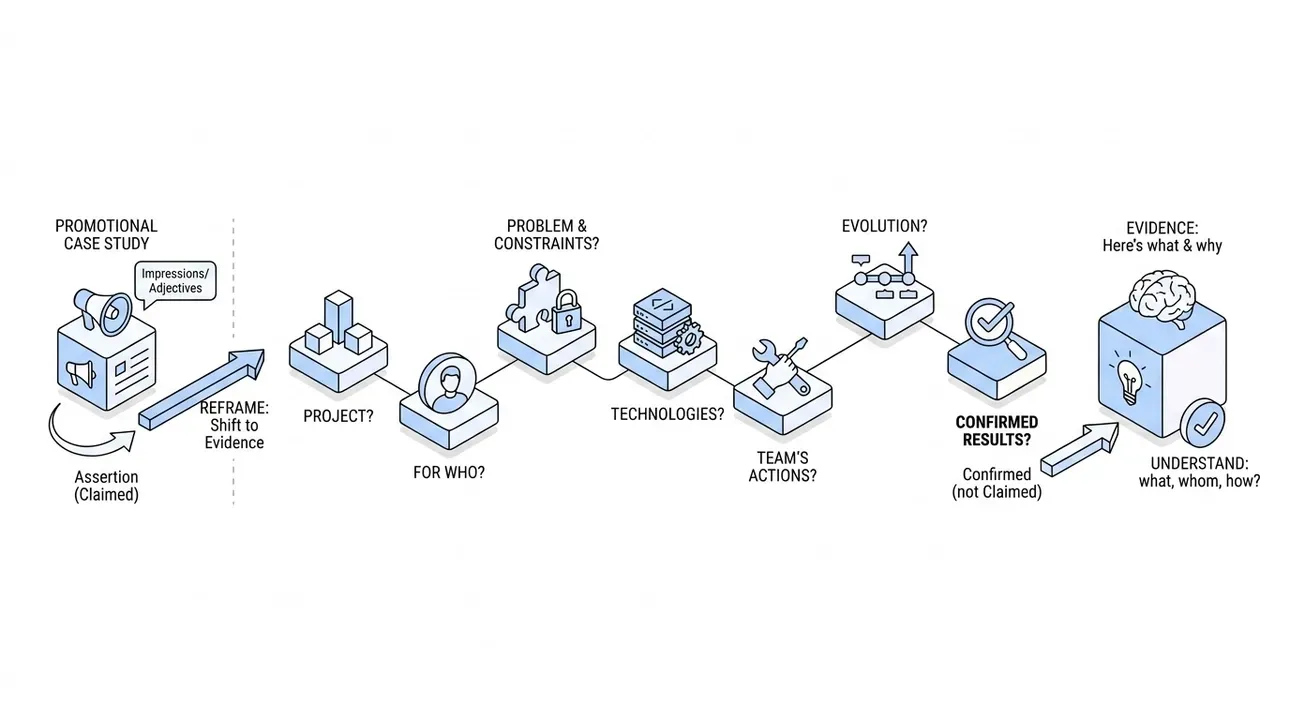
What was the project? Who was it built for? What problem were they trying to solve, and what constraints mattered? What technologies were used? What exactly did the team do? How did the product evolve over time? And finally, what results can be confirmed?
That last part is key: confirmed, not claimed. “We delivered an outstanding product” tells you nothing. “The client needed to handle X under constraints Y, so we built Z using these specific tools, and the product went through these stages” tells you something you can evaluate.
The shift is from assertion to evidence. From “we are great at this” to “here is what we did and why.” That reframe changes how every reader, human or automated, processes the information.
When we started sharpening our own project pages at Moonion, this was the core question we kept asking: can someone read this and actually understand what we built, for whom, and how? If the answer was no, the page needed work, regardless of how polished it looked.
Why AI Makes This Non-Negotiable
A human reader can extract meaning from a vague, flowery paragraph. They fill in gaps with assumptions, read between lines, and generally give you the benefit of the doubt. An AI language model does not do that.
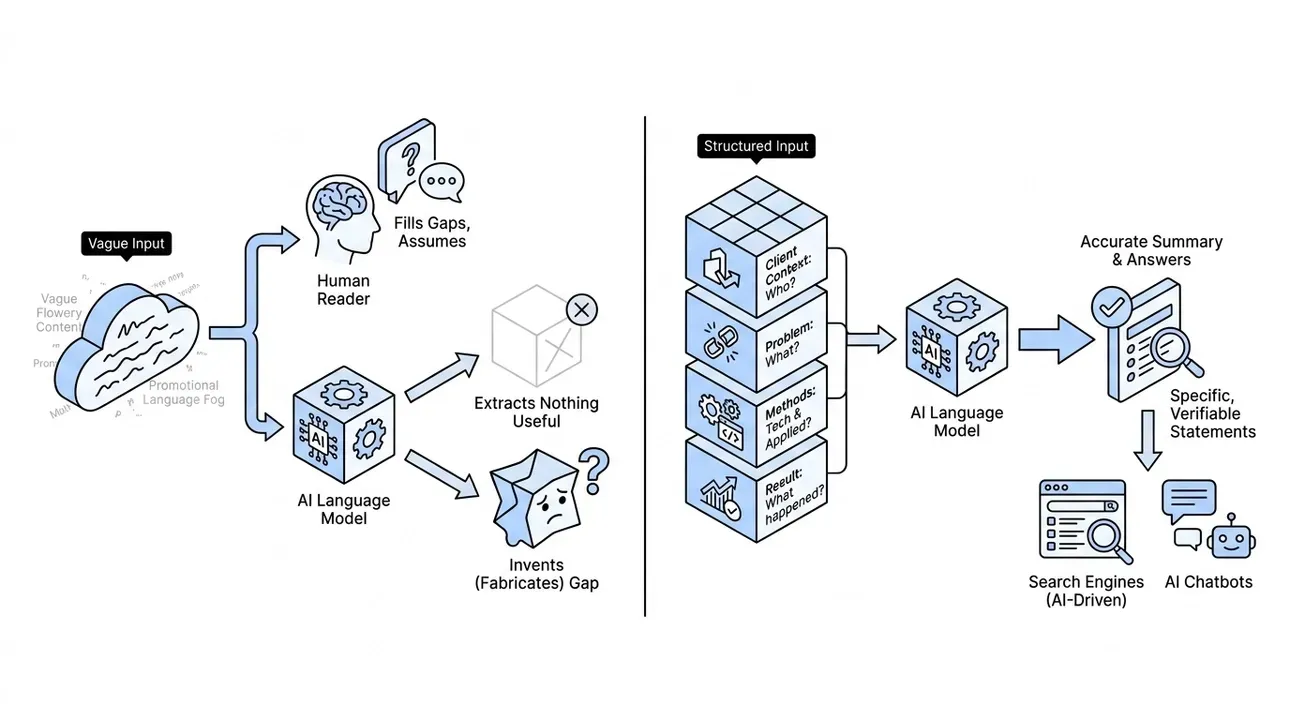
When an AI chat tries to summarize your case study or use it to answer a user’s question about your capabilities, it needs clean, discrete facts to work with. Who was the client context? What was the problem? What technologies and methods were applied? What happened as a result? If those answers are buried in promotional language or simply absent, the model has two options: extract nothing useful, or invent something to fill the gap.
We have been very deliberate about the second risk across this entire series. AI should not fabricate. But if you give it a fog of marketing copy, you are essentially inviting fabrication, because there is nothing solid to cite. A structured case study removes that invitation. It gives the model specific, verifiable statements it can safely use.
This is not a niche concern for companies thinking about AI chatbots. Search engines are increasingly AI-driven. The way your project pages get summarized, surfaced, and recommended depends on whether the content is structured enough to be parsed accurately. Vague content does not just fail to impress, it actively disappears.
How We Approached This at Moonion
We did not overhaul our portfolio in one pass. We worked through it gradually, which, honestly, is the more sustainable way to do it. The steps were sequential and deliberate: rewrite the core case study text to answer the key questions directly, refine section descriptions for clarity, add a product evolution timeline so the history of the work is visible, sharpen the partner context so the reader understands who we were working with and why, then tighten the meta description to match.
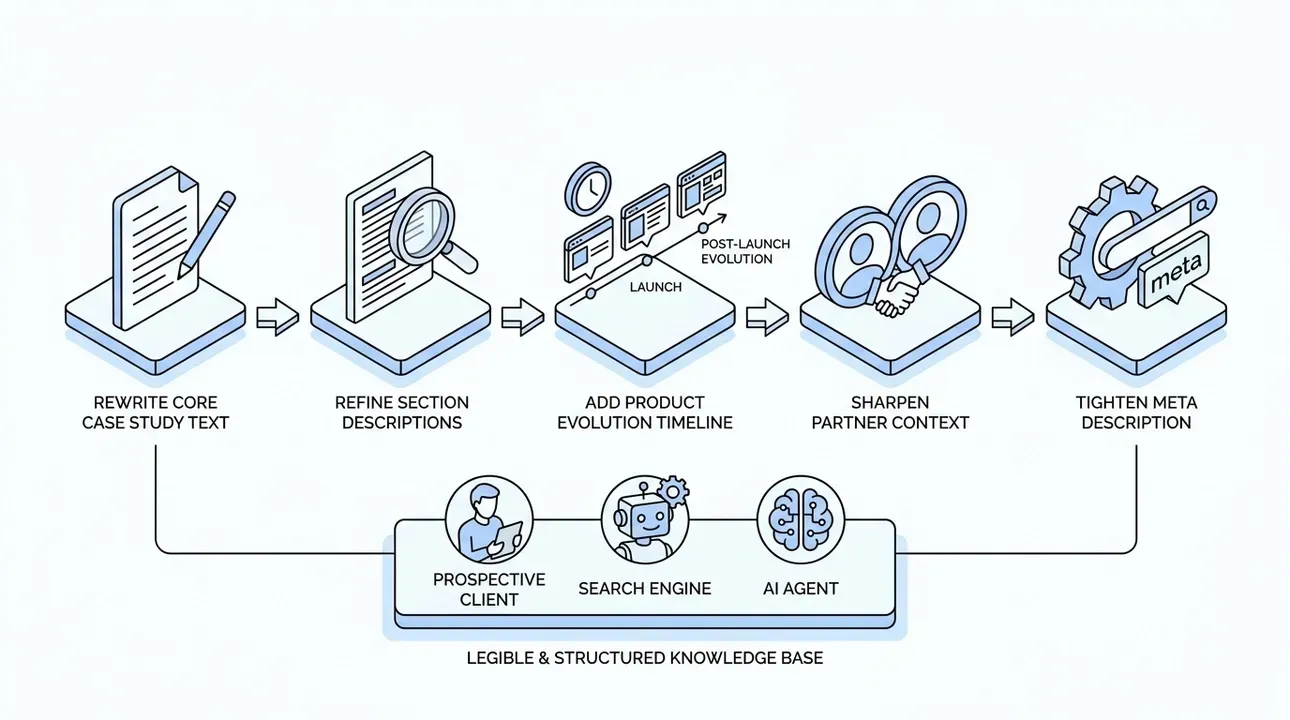
Each of those steps sounds small in isolation. Together, they transform what a portfolio is. It stops being a gallery of screenshots and becomes a structured record of decisions, constraints, technologies, and outcomes. A knowledge base of experience rather than a collection of images.
The goal was not to make the pages prettier. It was to make them legible: to a prospective client reading carefully, to a search engine parsing the structure, and to an AI agent trying to represent our work accurately.
One practical detail worth noting: the product evolution section is often the most overlooked part of a case study. People document what they built at launch and forget to show what changed after. But that evolution is part of the evidence. It shows that the work held up, that the team adapted, that the product was maintained and developed over time. Leaving it out makes a case study feel incomplete, because it is.
The Same Principle Works Beyond Portfolios
Case studies are the clearest application of this principle, but the logic extends anywhere you are trying to communicate facts about something specific.
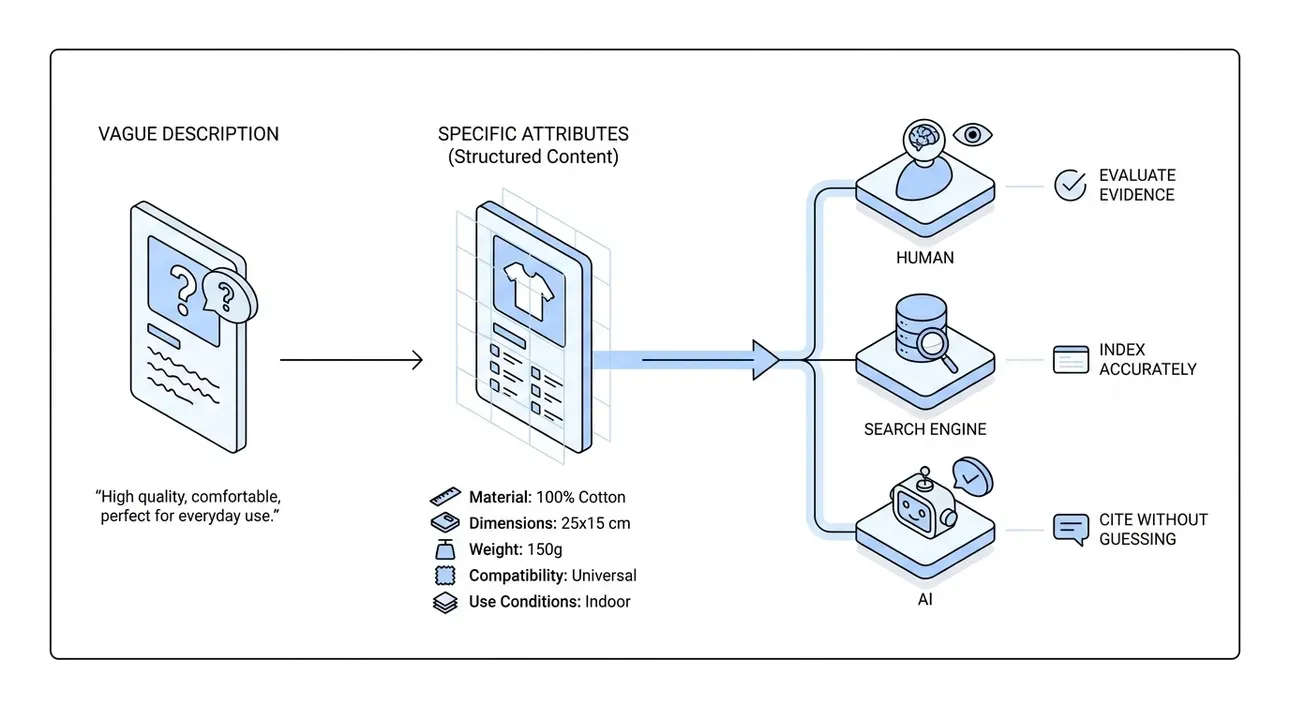
E-commerce product cards are a direct parallel. A card that says “high quality, comfortable, perfect for everyday use” is the product-page equivalent of a promotional case study. A card that lists specific materials, dimensions, weight, compatibility, and use conditions actually sells, because it answers the questions a buyer is asking. Specific attributes outperform vague descriptions, not because they sound better, but because they are more useful.
The underlying idea is the same: structured, factual content serves everyone in the chain. The human gets evidence they can evaluate. The search engine gets content it can index accurately. The AI gets facts it can cite without guessing.
What This Means in Practice
If you are looking at your own case studies or project pages right now, the test is straightforward. Can someone read the page and answer these questions without making assumptions?
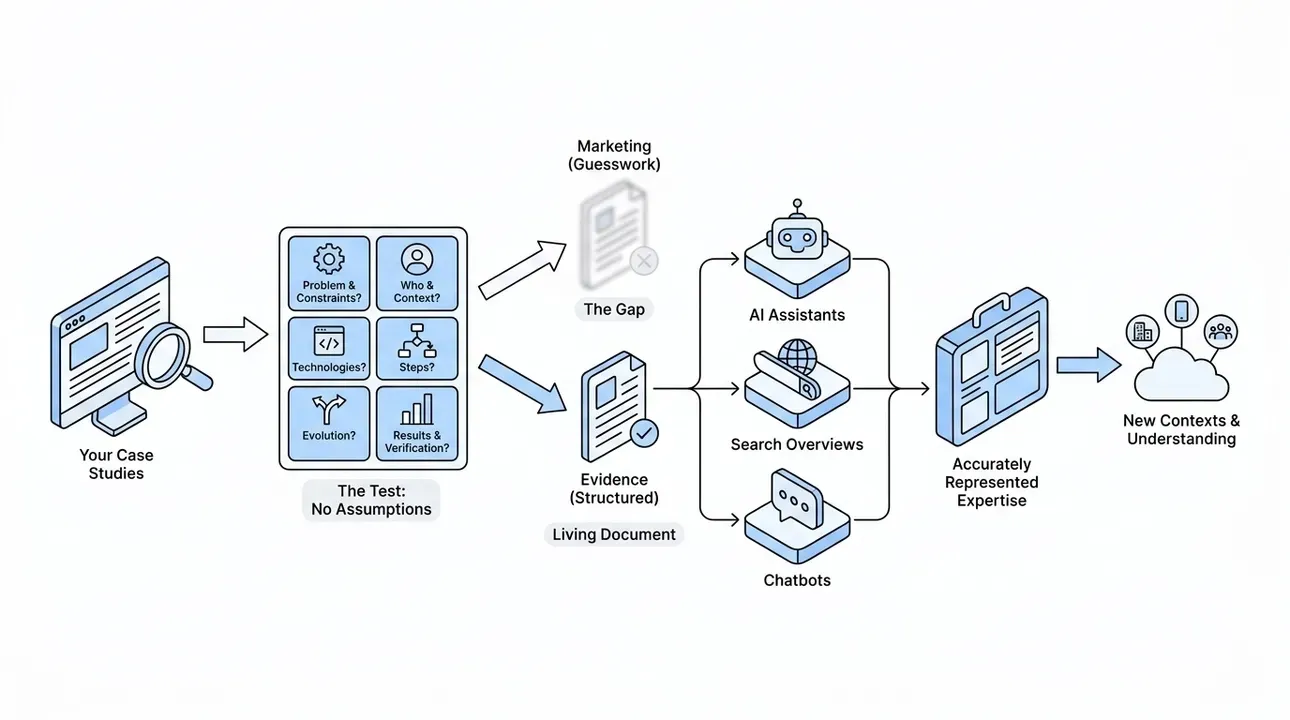
- What was the actual problem, and what constraints shaped the solution?
- Who was this built for, and what was their context?
- What specific technologies or methods were used?
- What did the team do, step by step?
- How did the product or project evolve after the initial delivery?
- What results are there, and how can they be verified?
If any of those answers require the reader to guess or take your word for it, the page is closer to marketing than evidence.
That gap matters more now than it did a few years ago. When AI assistants, search overviews, and chatbots are increasingly mediating how people find and evaluate services, the quality of your structured content determines whether your experience gets represented accurately or gets replaced by someone else’s better-organized page.
Case studies are not just for impressing potential clients in a first conversation. They are living documents that carry your expertise into contexts you will never be in the room for. The more precise and structured they are, the better they work in all of those contexts.
We built our portfolio to be read by people. Now we are building it to be understood by everything that reads on their behalf too.