How to Build an AI-Ready E-Commerce Store: The Data Model That Actually Works
By Mr. Oleksandr Nashyvan · CEO ·

An online store is, at its core, a large connected database presented to people. Products, categories, attributes, images, availability, pricing, shipping, returns, FAQs, reviews: every piece is structured data wearing a human-facing costume. Most stores treat it like content. That distinction is exactly where things break down, especially when AI enters the picture.
We have been building a demonstration catalog, a real working store on which we are testing everything described in this post against actual data volume. It is not yet published, but the data model is live and the workflows are running. We also have a first client for whom we are implementing this approach right now. So when we say this is not a hypothesis, we mean it literally.
The reason e-commerce demands extra care is that the cost of an error is higher here than almost anywhere else. A wrong fact on a blog post is an embarrassment. A wrong fact on a product card is a return, a complaint, or a lost customer. When AI is involved in generating or surfacing that content, the risk compounds. A model that “helpfully” fills in a missing specification, rewrites availability status, or approximates a price is not helping. It is creating liability.
The answer is not to avoid AI. The answer is to build a structure that makes it impossible for AI to guess at the things that matter most.
Start with the data model, not the copy
The most common mistake we see is teams reaching for AI-assisted copywriting before they have settled on how their data is actually organized. Copy is the last layer. The model is the foundation.
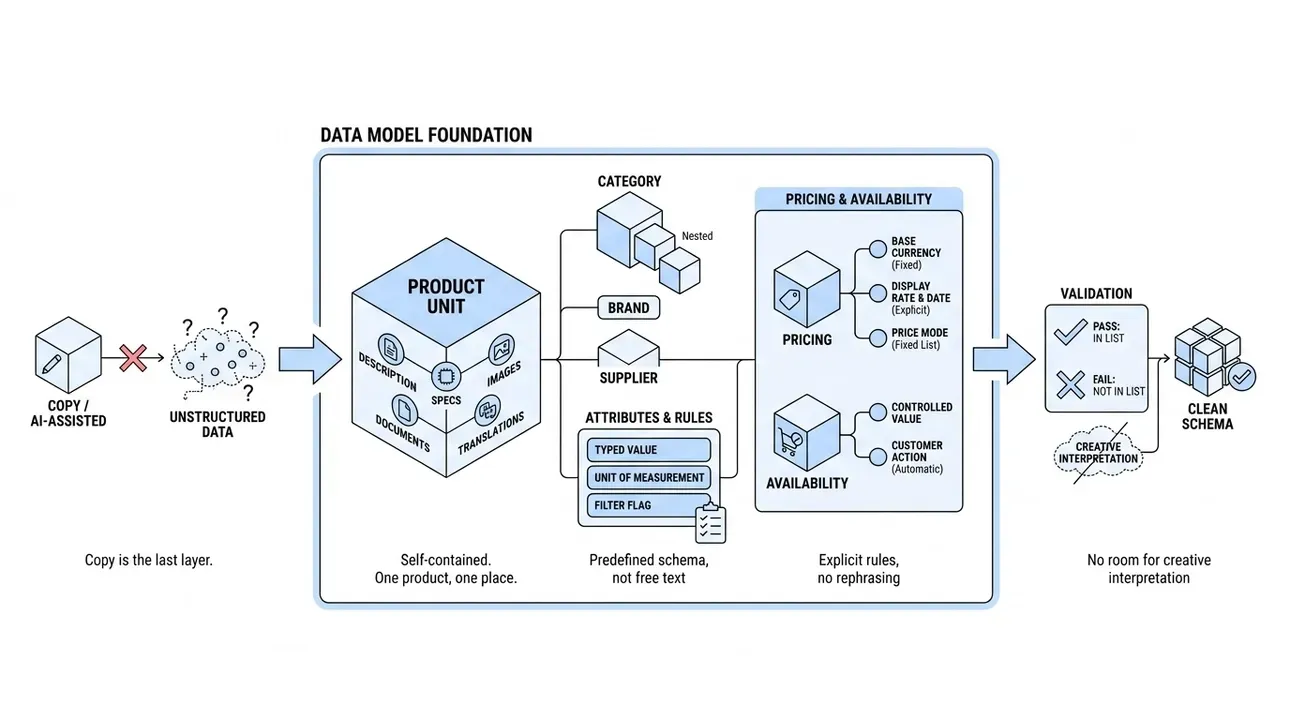
A product should not be a row in a database or a blob of HTML. It should be a self-contained unit where everything related to that product lives together: the description, the specifications, the images, the documents, and the translations. One product, one place. That discipline alone prevents a surprising number of errors because it is hard to accidentally corrupt something when everything about it is co-located and clearly bounded.
From there, relationships and rules do the heavy lifting. A product belongs to a category. It has a brand and a supplier. Its attributes are not drawn from free text but from a predefined set with typed values, units of measurement, and a flag for whether each attribute participates in filtering. Categories are nested, and products in a child category automatically appear in the parent. None of this requires clever AI. It requires deliberate schema design upfront.
Pricing and availability deserve special attention because they are the most sensitive fields in any store. These are not paragraphs that a model can rephrase. They are fields with explicit rules. The base currency of the catalog is fixed. Display rates and their last-updated date are declared explicitly. Price mode is chosen from a fixed list: fixed, starting from, ask for quote, hidden. Availability maps to a controlled set of values, and the correct customer-facing action, whether that is “add to cart,” “notify me,” or “request a quote,” is determined by that value automatically.
The rule is simple: if a value is not on the list, it does not pass validation. There is no room for creative interpretation, and that is exactly the point.
How supplier data flows in without breaking anything
In theory, catalogs are filled manually by a content team. In practice, stores live on supplier files. A new Excel or CSV arrives, covering hundreds or thousands of SKUs, and someone has to reconcile it with what already exists. This is precisely the scenario where a general-purpose AI assistant is most dangerous: it will confidently map columns, guess at missing values, and write things into your database that are wrong in ways you will not catch until a customer does.
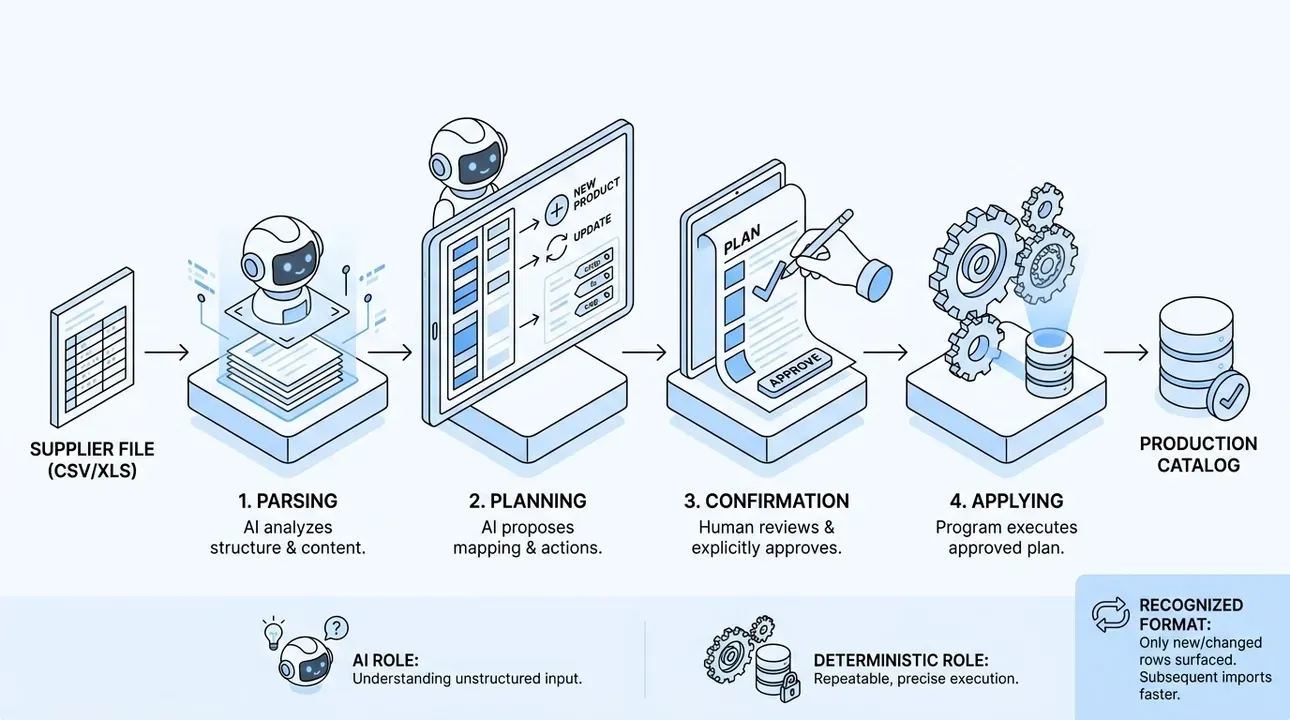
We handle this with a four-step process that keeps AI in a limited, well-defined role.
- Parsing. The agent opens the supplier file and describes what it sees: where the headers are, what each column contains, how values are formatted, whether the structure matches a previously seen file from the same supplier.
- Planning. The agent proposes a mapping: which columns become which attributes, which rows are new products versus updates to existing ones, what categories and brands are implied. The full plan is presented to a human before anything is written.
- Confirmation. The human reviews the plan, corrects it if needed, and explicitly approves it. Nothing is applied without that approval. Nothing.
- Applying. A deterministic program executes the approved plan. Not the model. A program. It does not re-interpret the file or make new judgments. It does exactly what was confirmed, and nothing else.
The principle here is the same one that runs through our entire content series: AI is good at understanding ambiguous, unstructured input, like a supplier’s idiosyncratic spreadsheet. It is not suited to making autonomous writes to a production catalog. The understanding step benefits from a model’s flexibility. The writing step requires determinism and repeatability.
One practical benefit of this approach is that a recognized supplier format only needs to be parsed once. On the second import, the system identifies the structure, and only new or changed rows are surfaced for review. The first import takes time. Every subsequent one takes minutes.
One source of facts, multiple languages
Multilingual stores introduce a specific failure mode that structured data prevents cleanly. When each language version of a product is managed as a separate document, factual drift becomes almost inevitable. Someone updates the price in the English version and forgets the French one. A spec changes in the original and the translation goes stale. Customers in different markets see different facts about the same product.
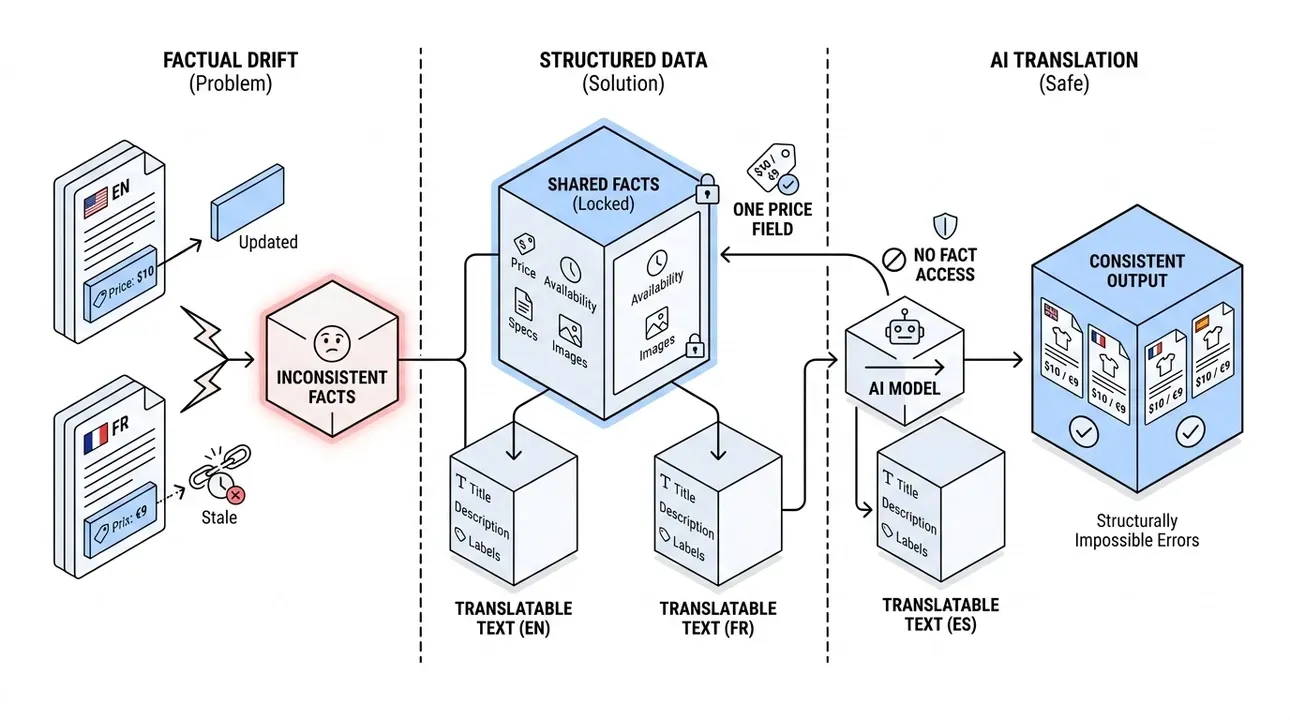
The fix is a strict separation between shared facts and translatable text. Price, availability, specifications, and images are stored once. They are not part of any translation. Translatable content, meaning titles, descriptions, and labels, exists per language, but it contains only text. When a price changes, it changes everywhere simultaneously because there is only one price field. Factual inconsistency across languages becomes structurally impossible, not a matter of process discipline.
This is also where AI genuinely helps and does so without risk. Translating product descriptions, generating multilingual FAQ entries, adapting category copy for a new market: these are all tasks where the model is working with text, not with facts. The facts are already locked. The model cannot get them wrong because it never touches them.
Why this structure determines your AI visibility
Consumers are increasingly asking AI systems to do what they used to do by scrolling: “Find me something like this,” “Compare these two options,” “What is the cheapest available version of this.” For a store to appear in those answers, its product data needs to be machine-readable and accurate.
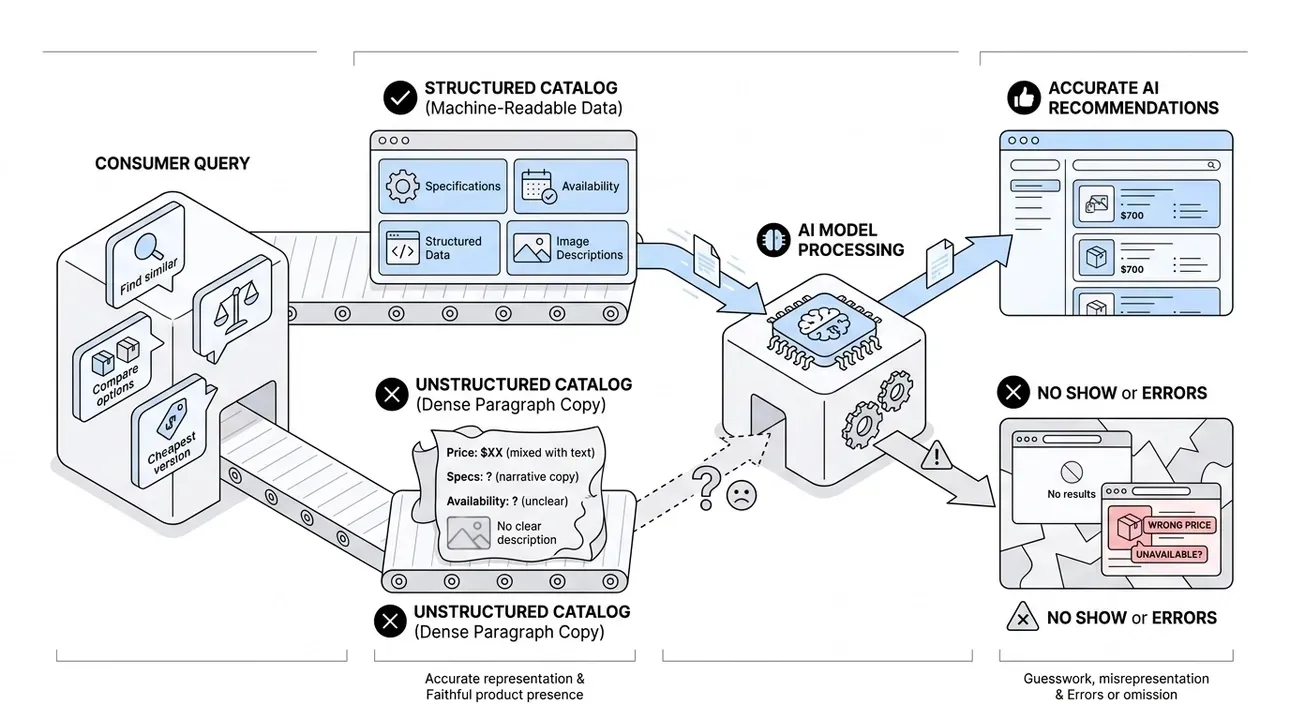
A model that encounters a well-structured product page with clear specifications, explicit availability, accurate structured data, and complete image descriptions can represent that product faithfully. A model that encounters a dense paragraph where price, availability, and specs are mixed into narrative copy has to guess, and it will sometimes guess wrong. Stores with clean, structured catalogs will show up in AI recommendations. Stores without them will not, or worse, will show up with errors attached.
This is not a prediction about what AI might eventually require. It is a description of how these systems work right now.
What AI does and what it does not do
The division of labor we apply to our e-commerce work is the same one we have described throughout this series, grounded more tightly here because the stakes are higher.
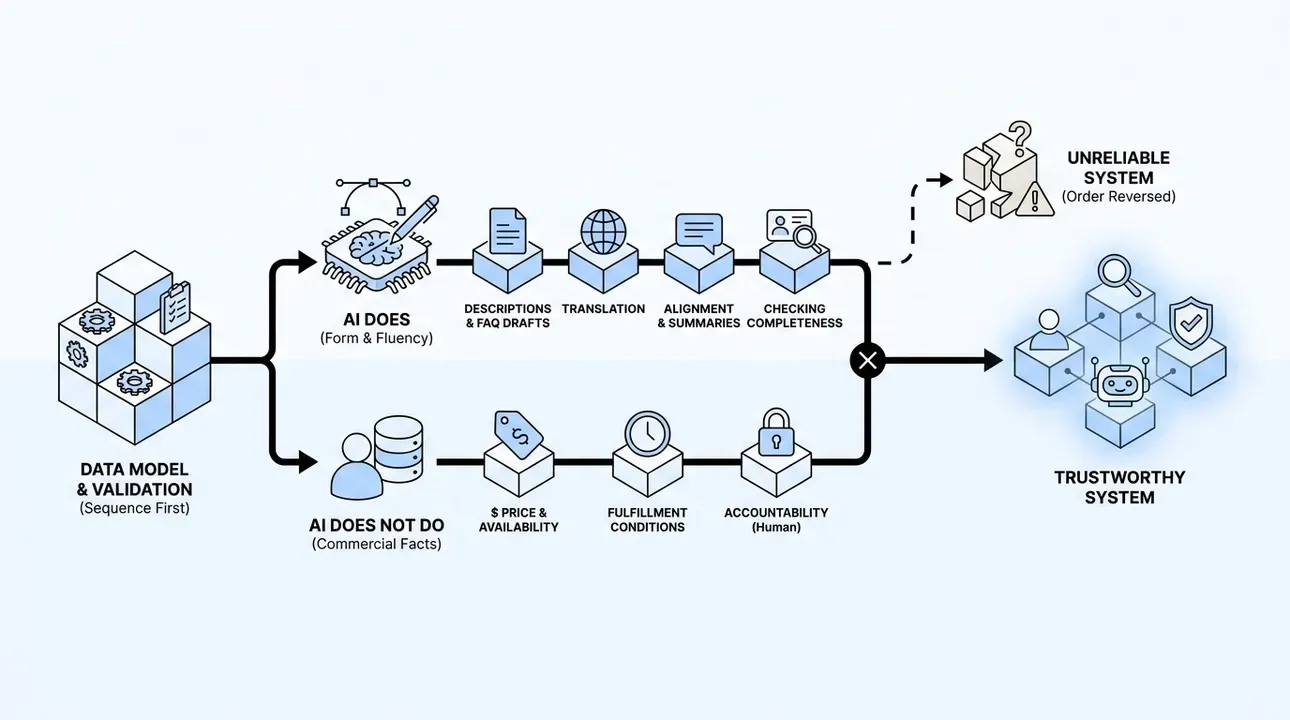
AI helps with form: writing clear product descriptions, drafting FAQ entries from real customer questions, bringing category naming into alignment, translating text, generating summaries for AI-facing layers of the site, checking card completeness (are dimensions included, is there a composition field, does every image have a description). These are exactly the tasks where a model’s fluency adds value and where an error is recoverable.
AI does not determine commercial facts. Price, availability, and fulfillment conditions come from your source of record, whether that is a supplier file, an ERP, or a manually maintained field. A human is accountable for their accuracy. The model works downstream of those facts, never upstream of them.
The sequence matters as much as the roles. Data model first. Validation rules second. Reliable data sources third. Then AI assists with the layer that benefits from language and judgment. Reverse that order and the whole system becomes unreliable in ways that are hard to trace and expensive to fix.
For any e-commerce business, an AI-ready catalog is not a technical nicety. It is the difference between a system that a customer, a search engine, and an AI assistant can all trust, and one that quietly misleads each of them in different ways. We are building that system right now. The path is clear, and the trade-offs are manageable. The harder part is deciding to start with the model instead of the copy.